9 Best Dual Fuel Generators for RVs (November 2026)
The best dual fuel generator for rv include the Westinghouse 5000 Peak Watt Super Quiet Dual for remote start convenience, the WEN 6800-Watt Dual Fuel RV-Ready Electric Start for high output and EV backup, and the Westinghouse 6500 Watt Dual Fuel Home Backup for home backup and RV use.
On this page (8 sections)
- The best dual fuel generators for RVs compared
- How to compare dual fuel generators for RV use
- What size dual fuel generator does an RV need
- Is propane or gasoline better for an RV generator
- How quiet should an RV dual fuel generator be
- What outlets and starting features matter for RV use
- Can solar and dual fuel work together in an RV
- Verdict: which dual fuel generator for RV use should you buy
The best dual fuel generator for RV use for most owners is the Westinghouse 5000 Peak Watt Super Quiet Dual, because it combines 3900 rated watts, remote start and a TT-30R outlet in one package. See our quiet dual fuel inverter generators guide for more models in this category.
If you need more power, the WEN 6800-Watt and AIVOLT 8000W cover larger loads.
If you need lighter weight, the WEN 3600-Watt and A-iPower 2300W are easier to carry.
RV dual fuel generators let you run on gasoline or propane, so you can use whichever fuel you can find on the road. Propane can extend runtime on a 20 lb tank, while gasoline often gives the highest rated watts.
Match RV power needs with flexible gasoline and propane operation, then check outlet type, weight and noise before you choose.
Our score weighs specs, features and buyer feedback against what RV owners need on the road. Remote start, RV ready outlets, clean power and runtime all affect that score.
Weight and noise also matter, because a generator you cannot move or cannot use at a campground does not help you.
Our picks at a glance
-
1
 Best for remote start convenience
Westinghouse 5000 Peak Watt Super Quiet Dual
9.7/10 our score
See it on Amazon -
2
 Best for high output and EV backup
WEN 6800-Watt Dual Fuel RV-Ready Electric Start
9.7/10 our score
See it on Amazon -
3
 Best for home backup and RV use
Westinghouse 6500 Watt Dual Fuel Home Backup
9.6/10 our score
See it on Amazon
- 4
 Check it
WEN Quiet and Lightweight 3600-Watt Dual Fuel
Best for quiet lightweight camping - 5
 Check it
Champion 4000-Watt Dual Fuel RV Ready Portable
Best for long propane runtime - 6
 Check it
PowerSmart 3800 Watt Dual Fuel Inverter Generator
Best for quiet eco mode camping - 7
 Check it
BILT HARD Dual Fuel Gas & Propane
Best for enclosed quiet design - 8
 Check it
AIVOLT 8000W Dual Fuel Inverter Generator 50A
Best for large 50A RV systems - 9
 Check it
A-iPower 2300W Dual Fuel Inverter Generator
Best for lightest basic loads
The best dual fuel generators for RVs compared
The Westinghouse 5000 Peak Watt Super Quiet Dual leads on balance, while the WEN 6800-Watt leads on output. The Champion and PowerSmart win on propane runtime.
The AIVOLT wins on pure watts but loses on weight and size.
Weight is the hidden divider in this group. Models under 60 lb can be carried by one person into storage, while models over 100 lb need wheels, a ramp or help.
The same split affects noise, because the light inverters here also have enclosed cases.
Outlet type is the second divider. Seven picks use an RV style outlet in some form, but only some use a TT-30R plug that fits a 30A trailer cord without an adaptor.
Check that detail early, because an adaptor adds cost and a loose point in the chain.
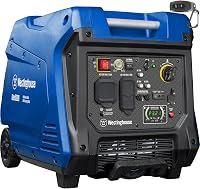
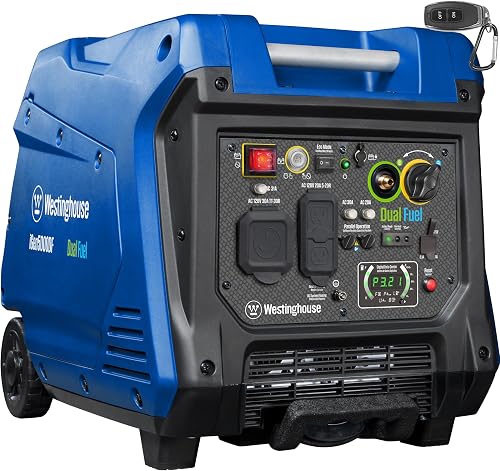
Westinghouse 5000 Peak Watt Super Quiet Dual: Best for remote start convenience
- 5000 peak watts, 3900 rated watts
- Remote electric start with key fob
- TT-30R 30A RV outlet
- Up to 18 hours on 3.4 gallon gasoline tank
- 52 dBA noise output
A quiet inverter with remote start and RV outlet that fits travel trailers needing clean power for essentials.
Pros
- Remote start with included key fob
- Long gasoline runtime at 18 hours
- TT-30R and household outlets included
Cons
- 104.7 lb weight needs wheels and handle
- Propane output is lower than peak gasoline figure
This Westinghouse suits owners who want push button starting from inside the RV. Remote start with the included key fob means you can start power without walking outside in rain or cold.
It also has electric and recoil start as backup.
You get 5000 peak watts and 3900 rated watts, which covers air conditioning plus fridge, lights and phone charging for many travel trailers. Clean power at less than 3 percent THD suits laptops and TVs.
The TT-30R 30A outlet fits most 30A RV cords directly.
Runtime reaches up to 18 hours on a 3.4 gallon gasoline tank, which is strong for overnight use. Economy mode helps stretch fuel when loads are light.
At 104.7 lb, it is not light, so use the telescoping handle and wheels.
The LED data center shows fuel level, output, remaining runtime, voltage and lifetime hours. That display helps you plan refills instead of guessing.
Parallel capability gives a path to more power later, while the 3 year warranty supports long term ownership.
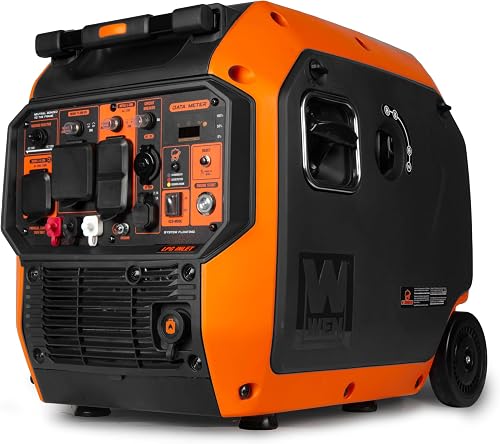
WEN 6800-Watt Dual Fuel RV-Ready Electric Start: Best for high output and EV backup
- 6800 surge watts on gasoline, 5100 rated
- 6000 surge watts on propane, 4500 rated
- TT-30R RV receptacle
- CO Watchdog shutdown sensor
- Fuel shutoff feature
Higher rated watts and 240V capability make this a strong pick for larger RV loads and vehicle charging.
Pros
- Highest gasoline rated watts in top tier
- 120V and 240V receptacle options
- CO shutdown sensor included
Cons
- 99.2 lb weight is heavy for frequent moves
- Propane rated watts drop to 4500
This WEN suits owners with larger RVs or a need for 240V power. 5100 rated watts on gasoline is the highest in the top tier here, and propane still gives 4500 rated watts.
That gap matters when you run air conditioning and other loads together.
The bonded neutral 240V setup supports low power Level 2 charging for battery and hybrid vehicles, according to WEN. You also get a TT-30R RV receptacle, two 120V outlets and USB ports.
The CO Watchdog sensor shuts the unit down if carbon monoxide rises.
At 99.2 lb, it is still heavy but lighter than the Westinghouse 6500 Watt open frame model. Fuel shutoff helps use remaining carburetor fuel before shutdown, which can reduce maintenance over time.
The 224 cc engine runs at 64 decibels at quarter load.
Total harmonic distortion stays under 0.3 percent at no load and under 1.2 percent at full load. That clean output suits laptops, phones and tablets.
The trade off is size, because a 240V capable unit takes more storage space than a small inverter.
Westinghouse 6500 Watt Dual Fuel Home Backup: Best for home backup and RV use
- 6500 peak watts, 5300 running watts on gasoline
- 5800 peak watts, 4800 running watts on propane
- TT-30R 30A RV outlet
- L14-30R transfer switch ready outlet
- 4.7 gallon fuel tank
An open frame model that doubles for home backup while keeping an RV ready outlet for travel trailers.
Pros
- Transfer switch ready outlet for home use
- Long 14.5 hour gasoline runtime
- Wheel kit included
Cons
- 135.6 lb weight is the heaviest in top three
- Open frame design is louder than inverters
This Westinghouse suits owners who want one generator for the RV and for home backup. Transfer switch ready L14-30R outlet makes it a dual purpose pick, while the TT-30R outlet serves the RV.
That flexibility is rare in this group.
You get 5300 running watts on gasoline and 4800 on propane, plus up to 14.5 hours from a 4.7 gallon tank. The 274 cc engine, fuel gauge and CO shutdown are included.
Rubber covers protect the outlets.
At 135.6 lb, it is the heaviest of the top three picks. The hardened steel frame and never flat wheels help on rough ground, but storage still needs planning.
Expect more noise than an inverter model. If you camp in quiet sites often, an inverter pick may suit you better than this open frame design.
The 120 and 240 volt selector switch lets you match home or RV loads. Automatic low oil shutdown protects the engine during long runs.
This is a home first pick that also travels, rather than a travel first pick that also works at home.
WEN Quiet and Lightweight 3600-Watt Dual Fuel: Best for quiet lightweight camping
- 3600 surge watts, 2900 rated watts on gasoline
- 3500 surge watts, 2600 rated watts on propane
- TT-30R RV receptacle
- 49 lb weight
- CO Watchdog shutdown sensor
A 49 lb inverter that suits smaller RVs and campground use where quiet operation matters more than peak watts.
Pros
- Lightest top tier option at 49 lb
- Quiet operation for campground settings
- Tool free propane connector
Cons
- 2900 rated watts limits air conditioner loads
- 1.5 gallon tank gives shorter runtime
This WEN suits smaller RVs and owners who carry the generator by hand. At 49 lb, it is far lighter than the 100 lb models above.
That difference shows up when you load it into a truck bed or RV storage bay.
You get 2900 rated watts on gasoline and 2600 on propane, which fits lights, fans, fridge and small appliances. It may struggle with a large air conditioner plus other loads at the same time.
The TT-30R outlet keeps RV hookup simple.
Clean power under 1.2 percent THD at full load suits phones, tablets and laptops, according to WEN. The 149 cc engine runs at 65 decibels at quarter load.
The 1.5 gallon tank gives up to 5 hours at half load, so propane can help extend your time between refills.
Fuel shutoff uses remaining carburetor fuel before shutdown to limit maintenance. The CO Watchdog sensor adds a safety layer for campsite use.
This pick trades peak power for portability, and that trade makes sense for pop ups and small trailers.
Champion 4000-Watt Dual Fuel RV Ready Portable: Best for long propane runtime
- 4000 starting watts, 3000 running watts on gasoline
- 2700 running watts on propane
- Up to 25 hours on 20 lb propane tank
- TT-30R 25A outlet
- 51.8 lb weight
Propane runtime up to 25 hours makes this a practical pick for longer stays without refilling gasoline.
Pros
- 25 hour propane runtime at 25 percent load
- CO Shield auto shutoff
- Parallel ready for added power
Cons
- Recoil start only, no electric start
- 3000 running watts is mid range
This Champion suits owners who want long propane runtime without changing tanks often. Up to 25 hours on a 20 lb propane tank at 25 percent load is a major advantage for weekend trips.
Gasoline runtime is up to 10 hours.
You get 3000 running watts on gasoline and 2700 on propane, with 64 dBA from 23 feet. The CO Shield system shuts the unit down if carbon monoxide is detected.
At 51.8 lb, it is easy to move compared with the larger models.
It uses recoil start rather than electric start, so starting takes more effort. Cold Start Technology helps in cold weather, and the EZ Start dial keeps fuel switching simple.
The TT-30R outlet is 25A rather than 30A, so check your RV cord and load before pairing them.
Parallel capability adds power later if you buy the kit. The included propane hose, oil and funnel get you running out of the box.
This is a runtime first pick, and that focus shapes both its strengths and its limits.
PowerSmart 3800 Watt Dual Fuel Inverter Generator: Best for quiet eco mode camping
- 3800 starting watts, 3300 running watts on gasoline
- 3500 starting watts, 3100 running watts on propane
- 59 dBA at 25 percent load
- Up to 24 hours on 20 lb propane tank
- 50.7 lb weight
Low noise and long propane runtime suit RV owners who camp near other people and want eco mode efficiency.
Pros
- 59 dBA noise rating at 25 percent load
- 24 hour propane runtime
- CO sensor and low oil shutdown
Cons
- No TT-30R outlet, uses L5-30R
- 1.3 gallon gasoline tank is small
This PowerSmart suits owners who camp near neighbors and want low noise. 59 dBA at 25 percent load in eco mode is the lowest noise figure in this group.
That can matter at crowded campgrounds.
You get 3300 running watts on gasoline and 3100 on propane, plus up to 24 hours on a 20 lb propane tank. At 50.7 lb, it is light enough for most owners to carry.
CO sensor, overload and low oil protection are included.
The outlet layout uses a 120V 30A L5-30R twist lock rather than a TT-30R. You may need an adaptor for some RV cords.
The 1.3 gallon gasoline tank is small, so propane is the better choice for longer runs.
The 149 cc engine and clean power under 3 percent THD suit sensitive electronics. Parallel ready operation lets you link two units for more power.
Certifications listed include ANSI standards and EPA compliance, which helps with campground rules.
BILT HARD Dual Fuel Gas & Propane: Best for enclosed quiet design
- 4500 peak watts, 3500 rated watts on gasoline
- 4150 peak watts, 3200 rated watts on propane
- TT-30R 30A outlet
- 58 dBA at 23 feet
- 57.7 lb weight
An enclosed inverter with TT-30R outlet and parallel capability for owners adding a second unit later.
Pros
- 58 dBA noise level
- Parallel capable with kit not included
- CO sensor with auto shutdown
Cons
- Parallel kit is not included
- Recoil start only
This BILT HARD suits owners who want an enclosed design and future parallel options. 58 dBA noise at 23 feet keeps it campground friendly.
The enclosed body also helps reduce sound compared with open frame models.
You get 3500 rated watts on gasoline and 3200 on propane, with a TT-30R 30A outlet for direct RV hookup. USB ports and a 12V DC outlet add charging options.
The CO sensor shuts the engine down in unsafe conditions.
At 57.7 lb, it sits in the middle for weight. The 141 cc engine and eco mode help manage fuel use, with runtime listed at 13 hours.
The parallel kit is not included, so budget for that part if you plan to link two units.
Recoil start means no remote or electric start, which is a trade off at this price point. Circuit breaker protected outlets add a safety layer for mixed loads.
This pick balances quiet operation and RV hookup for owners who do not need remote start.
AIVOLT 8000W Dual Fuel Inverter Generator 50A: Best for large 50A RV systems
- 8000 surge watts, 6100 running watts on gasoline
- 7200 surge watts, 5500 running watts on propane
- 50A RV generator design
- 62 dBA at 23 feet
- 130.7 lb weight
The largest output here suits bigger coaches and owners who need 50A service rather than 30A.
Pros
- Highest running watts in the group
- 50A design for large RVs
- Electric start with low temperature battery
Cons
- 130.7 lb weight is heavy to move
- Lower score reflects size and weight trade off
This AIVOLT suits large coaches and 50A RV systems. 6100 running watts on gasoline is the highest here, and propane gives 5500 running watts.
That output can run two air conditioners in some coaches, depending on starting needs.
You get a 5-in-1 LCD display, electric start and CO Alert shutdown. The 322 cc engine and eco mode help manage fuel use.
Runtime is over 10 hours at 25 percent load, according to AIVOLT. The upgraded lithium battery supports electric start in temperatures from -4 to 140 degrees Fahrenheit.
At 130.7 lb, it is heavy and needs the telescopic handle and wheels. The 62 dBA rating from 23 feet is quiet for its size.
It scores lower here because most travel trailers do not need 50A output.
If you own a smaller RV, a 30A model will be easier to store and move. This pick earns its place only when coach size demands high continuous watts.
Copper windings and automatic fuel switching are useful, but they do not erase the weight cost.
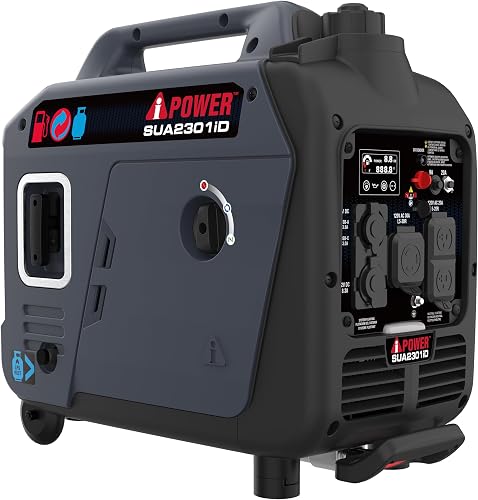
A-iPower 2300W Dual Fuel Inverter Generator: Best for lightest basic loads
- 2300 starting watts, 1800 running watts on gas
- 2000 starting watts, 1600 running watts on propane
- L5-30R 30A outlet
- 40.3 lb weight
- 61 dB sound level
At 40.3 lb this is the lightest pick for running lights, fans and small electronics in a smaller RV.
Pros
- Lightest option at 40.3 lb
- 30A RV adaptor included
- Parallel cable included
Cons
- 1800 running watts limits appliance use
- No TT-30R outlet included
This A-iPower suits small RVs and basic loads. At 40.3 lb, it is the lightest pick in this roundup.
That makes it easy to carry from storage to a campsite or tailgate spot.
You get 1800 running watts on gas and 1600 on propane, which fits lights, fans, phone chargers and a small TV. It is not enough for a large air conditioner plus electric water heater at the same time.
Clean power at 3 percent THD suits sensitive electronics.
The L5-30R 30A outlet and included 30A RV adaptor help with hookup. A parallel cable is included, so you can add a second unit later.
The 80 cc engine and low idle technology help with fuel use and noise at 61 dB.
The CO sensor, LED light and data center display add useful detail for a small unit. If your RV has high power needs, step up to a 3600 or 4000 watt model instead.
This pick is about portability first, and power second.
How to compare dual fuel generators for RV use
We compared rated watts on both fuels, RV outlet type, runtime, noise and weight across all nine picks. We checked the specs for each model rather than relying on peak watts alone.
Rated watts tell you what the generator can run continuously. Peak or surge watts tell you what it can handle for a short start.
For RV use, rated watts on propane matter if you plan to run on propane most of the time.
We also checked outlet type because a TT-30R outlet fits many 30A RV cords directly. An L5-30R outlet may need an adaptor.
A 50A outlet suits larger coaches but adds weight and size.
What to check first
Start with your RV cord plug, then your air conditioner starting watts, then your storage space. Those three checks remove most wrong picks before you compare brands.
Weight comes next, because a model over 100 lb needs a plan for loading and unloading.
Fuel access comes last but still matters. If you mostly camp where propane is easy to get, propane runtime should weigh more in your choice.
If you mostly run heavy loads, gasoline rated watts should weigh more.
For a broader look at fuel types, our gas generator guide explains how gasoline models differ from dual fuel and inverter designs. That context helps you decide if dual fuel is worth the extra cost for your travel style.
What size dual fuel generator does an RV need
A 30A travel trailer often needs 3000 to 5000 running watts, depending on air conditioning and other loads. Add up your must run appliances first, then check starting watts for the air conditioner.
For 30A travel trailers
Look at models in the 3600 to 5000 watt range for most 30A trailers. The Westinghouse 5000 Peak Watt and WEN 3600-Watt cover that need at different weights.
Our best 4000 watt generator for rv guide breaks down that middle range in more detail.
For 50A coaches
Look at 6000 watts or more for 50A coaches with two air conditioners. The AIVOLT 8000W and WEN 6800-Watt fit that need better than smaller inverters.
Check your coach label before choosing a 50A model.
For small RVs and pop ups
Look at 2000 to 3000 watts for pop ups and small campers. The A-iPower 2300W fits basic loads and weighs only 40.3 lb.
You will save storage space and carrying effort with a smaller unit.
How starting watts change the math
Air conditioners need extra watts for a short start surge. A generator that looks strong on rated watts can still fail to start a large air conditioner if surge watts are low.
Add the air conditioner starting need to your running load list before you narrow the field.
Is propane or gasoline better for an RV generator
Propane often gives longer runtime and easier storage, while gasoline often gives higher watts. Dual fuel lets you choose based on fuel access and load.
Propane advantages
Propane can run for up to 25 hours on a 20 lb tank with the Champion model. It also stores cleanly and avoids stale gasoline in the carburetor.
Our best propane generator for camping guide covers propane runtime in more depth for campground use.
Gasoline advantages
Gasoline gives the highest rated watts on most models here. The WEN 6800-Watt gives 5100 rated watts on gasoline versus 4500 on propane.
Gas stations are also easier to find than propane exchanges in some areas.
When to switch fuels
Use propane for quiet camping and long stays. Use gasoline when you need maximum watts for air conditioning or charging.
Switch only when the generator is off and cool, and follow the manual for your model.
Storage and maintenance differences
Fuel shutoff on the WEN models helps use remaining carburetor fuel before shutdown. That feature reduces the build up linked to stagnant fuel.
Propane storage also avoids some gasoline issues, but oil checks and air filter care still apply on both fuels.
How quiet should an RV dual fuel generator be
Campground generators should stay under about 60 dBA if possible. Inverter models with enclosed cases are usually quieter than open frame models.
Inverter versus open frame noise
Inverter models in this roundup range from 58 to 65 dBA depending on load. The BILT HARD and PowerSmart are among the quietest here.
Open frame models like the Westinghouse 6500 Watt are louder but offer home backup features.
Eco mode and load
Eco mode lowers engine speed at light loads, which cuts noise and fuel use. Most inverters here have eco or economy mode.
Runtime figures often assume light loads, so real world runtime will be shorter under heavy load.
Placement tips
Place the generator downwind and away from open windows. Distance helps more than any single feature.
Never run a generator inside an enclosed space, and keep it away from sleeping areas.
What outlets and starting features matter for RV use
A TT-30R outlet, remote start and CO shutdown matter more than extra household outlets for most RV owners. Check your RV cord plug before you order.
TT-30R RV outlet
Most 30A travel trailers use a TT-30R plug. Models with that outlet include the Westinghouse 5000 Peak Watt, WEN 6800-Watt and Champion 4000-Watt.
A direct fit saves you from carrying an adaptor.
Remote and electric start
Remote start lets you start power from inside the RV. Our best remote start generator for rv picks focus on that feature for cold or wet mornings.
Electric start without remote is still easier than recoil start.
Safety sensors
CO shutdown sensors are now common on RV ready models. WEN, Champion and PowerSmart all list CO protection in this group.
Treat the sensor as a safety backup, not a reason to run the generator near sleeping areas.
Extra outlets and charging ports
USB ports and 12V DC outlets help charge phones and small devices without using AC outlets. Those ports are useful, but they should not decide your pick over RV outlet fit and rated watts.
Check voltage and outlet layout before you buy an adaptor.
Can solar and dual fuel work together in an RV
Solar can charge batteries during the day, while a dual fuel generator can run appliances or recharge batteries on cloudy days. That mix suits longer trips off grid.
You can learn more about solar pairing in our guide on How To Install Solar Generator In RV?. A generator still gives you power at night or in bad weather when solar output drops.
Our best rv ready generator guide covers RV outlet and safety features in more depth. Our Best Propane Hybrid Generator guide covers hybrid options if you want propane plus another power source.
Together, those guides help you plan a full RV power setup.
Sizing the mix
Solar works best for daytime charging and light loads. A generator works best for air conditioning, electric water heat and fast battery charging.
Size the generator for the loads solar cannot cover, and size solar for the loads you run most days.
Verdict: which dual fuel generator for RV use should you buy
Pick the Westinghouse 5000 Peak Watt Super Quiet Dual if you want remote start, clean power and long runtime in one package. Pick the WEN 6800-Watt if you need higher watts or 240V power.
Pick the Champion 4000-Watt if propane runtime matters most.
Pick the WEN 3600-Watt or PowerSmart 3800 Watt if you want light weight and low noise for campground use. Pick the AIVOLT 8000W only if you own a large 50A coach.
Pick the A-iPower 2300W only for small RVs with basic loads.
Before you buy, check your RV cord plug, your air conditioner starting watts and your storage space. That trio of checks will narrow this list faster than peak watts alone.
Then choose the fuel you will use most often and size the generator for that fuel, not the other one.
Our top 3 picks at a glance
-
1
Best for remote start convenience
Westinghouse 5000 Peak Watt Super Quiet Dual
9.7/10 our score
See it on Amazon -
2
Best for high output and EV backup
WEN 6800-Watt Dual Fuel RV-Ready Electric Start
9.7/10 our score
See it on Amazon -
3
Best for home backup and RV use
Westinghouse 6500 Watt Dual Fuel Home Backup
9.6/10 our score
See it on Amazon
Frequently asked questions
What size dual fuel generator do I need for an RV?
Most 30A travel trailers need 3000 to 5000 running watts for air conditioning, fridge and basic appliances. Check your RV label first, then add starting watts for the air conditioner.
Larger 50A coaches may need 6000 watts or more.
Is propane or gasoline better for an RV dual fuel generator?
Propane often gives longer runtime and cleaner storage, while gasoline usually gives higher watts and faster refilling. Many owners use propane for quiet camping and gasoline for heavy loads.
Dual fuel lets you switch based on fuel access.
Do I need a TT-30R outlet for my RV generator?
A TT-30R outlet matches most 30A travel trailer cords directly. Without it you may need an adaptor, which adds bulk and another connection point.
Check your cord plug before ordering.
Can a dual fuel inverter generator run sensitive electronics?
Inverter models with less than 3 percent THD are designed for laptops, TVs and phone chargers. Check the THD figure in the specs rather than assuming every generator is safe for electronics.
Open frame models may not offer the same clean output.