8 Best Folding Solar Panels (November 2026)
The best folding solar panels include the ZOUPW 100W Portable Solar Panel for Power for compact camping, the Renogy 400W Portable Solar Panel for high-capacity stations, and the DOKIO 200W Portable Foldable Solar Panel Kit for 12V battery charging.
On this page (10 sections)
- How we compared these best folding solar panels
- The best folding solar panels for different camping jobs
- How folding solar panel construction affects daily use
- What packed size and weight mean on a real camping trip
- Can foldable solar panels charge a portable power station?
- How many watts do you need for camping power?
- Which connectors and charging ports should you look for?
- How do N-type cells and efficiency claims compare?
- How should you set up and care for a folding panel?
- Best folding solar panels: our verdict
The best folding solar panels for most campers are the ZOUPW 100W and Renogy 200W, because they pack small, connect to common power stations and charge small devices directly. Pick a 400W or 450W model only for a large station that accepts its higher voltage.
Our score weighs specs, features and buyer feedback against what you're shopping for. We compared folded size, weight, efficiency, connector coverage and charging ports, then matched each panel to the camping job it suits best.
If you are still deciding what a portable panel can do, start with our guide to what is the best solar panel and our Best Solar Panel For Camping guide. If you want to know whether charging an electric vehicle is realistic, read portable solar panel for ev charging.
Our picks at a glance
-
1
 Best for compact camping
ZOUPW 100W Portable Solar Panel for Power
9.6/10 our score
See it on Amazon -
2

-
3
 Best for 12V battery charging
DOKIO 200W Portable Foldable Solar Panel Kit
9.5/10 our score
See it on Amazon
- 4
 Check it
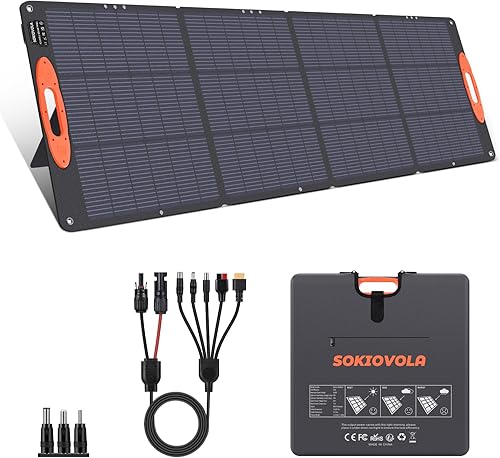
SOKIOVOLA N-Type 16BB 200W Portable Solar Panel
Best for N-type efficiency - 5
 Check it
Renogy 200W Portable Solar Panel for Power
Best for Renogy ecosystems - 6
 Check it
ZOUPW 450W Portable Solar Panel N-Type 16BB
Best for large 40V stations - 7
 Check it
Ecosonique Technology 400W Portable Solar Panel for Power
Best for portable 400W value - 8
 Check it
Ecosonique 200W Portable Foldable Solar Panel MC4
Best for ultra-compact 200W
How we compared these best folding solar panels
We checked each panel against its stated wattage, efficiency, folded dimensions and weight. We also checked connector types, because a panel that needs a separate adapter costs more and adds one more part to pack.
Construction matters for daily use. ETFE coatings, fiberglass reinforcement, Oxford cloth and kickstand design affect durability, glare and how easily you can aim the panel at the sun.
We treated stated efficiency as a maker claim under standard test conditions. Real output changes with sun angle, shade, temperature, cable length and your power station input limit.
The best folding solar panels for different camping jobs
The top picks split by use rather than by brand. A 100W panel wins on portability, a 200W panel wins on balance and a 400W panel wins on fast recovery for large stations.
ZOUPW 100W Portable Solar Panel for Power: Best for compact camping
- 100W maximum power
- 23.5% efficiency
- 9.5 lb weight
- Folds to 24.13 x 21.06 x 1.77 in
- 5-in-1 connector cable
- USB-C and dual USB-A outputs
A compact 100W panel with broad connector coverage and direct USB charging for phones, tablets, GPS units and cameras.
Pros
- Folds to a compact size
- Includes 5-in-1 connector cable
- Charges devices directly by USB
- IP67 waterproof panel surface
Cons
- 100W is modest for large power stations
- USB hub and cables need protection from moisture
The ZOUPW 100W suits campers who want one panel for a small power station and direct phone charging. It weighs 9.48 lb and folds to 24.13 x 21.06 x 1.77 in, so it fits in a trunk or storage bin without taking over the car.
Its 23.5% efficiency and adjustable kickstands help you aim for more sun than a flat panel. For easier repositioning, see this portable solar panel stand.
The built-in controller adds USB-C PD and two USB-A ports, including QC3.0 on one port.
The 5-in-1 cable covers XT60, Anderson, DC7909, DC8020 and DC5521 connectors. That wide coverage reduces the chance that you need an extra adapter for Jackery, EcoFlow, Anker or Bluetti stations.
The trade-off is output. A 100W panel will top up a small station well, but it will take much longer to recover a large power station after heavy use.
Renogy 400W Portable Solar Panel: Best for high-capacity stations
- 400W maximum power
- 23% efficiency
- 30.2 lb weight
- Folds to 33.7 x 27.95 in
- MC4 output only
- IP67 waterproofing
A high-output 400W suitcase built for larger power stations, with fiberglass reinforcement and a carry case for RV and emergency use.
Pros
- High 400W output
- Includes carry case
- Reinforced fiberglass structure
- Designed for partial shade resistance
Cons
- Needs a separate 4-in-1 adapter cable
- Heavier than 200W options
- Large folded footprint
The Renogy 400W suits RV owners and basecamp users with a high-capacity power station. It delivers 400W from a panel that folds to 33.7 x 27.95 in and weighs 30.2 lb, which is heavy for hiking but fine for a truck or trailer.
Renogy uses fiberglass reinforcement, ETFE coating and Grade A+ monocrystalline cells. The maker says the panel resists partial shade through parallel wiring, which helps when trees or clouds cross part of the surface.
You get MC4 output only. A Renogy 4-in-1 adapter cable is sold separately, so budget for that cable if your station does not use MC4.
The trade-off is size. This panel is a power tool for basecamp, not a lightweight backpacking panel.
Compare it with the best renogy folding solar panel guide before you choose.
DOKIO 200W Portable Foldable Solar Panel Kit: Best for 12V battery charging
- 200W panel kit
- 9.7 lb weight
- Folds to 20 x 27 x 1.1 in
- Separate PWM controller
- 9.84 ft cable
- Dual USB ports
A light 200W kit aimed at 12V batteries, with a separate controller and a long cable for flexible placement.
Pros
- Very light for 200W
- Separate PWM controller included
- Long 9.84 ft cable
- Dual USB ports for small devices
Cons
- Panel weight does not match all listed watt figures
- Check power station input limits closely
The DOKIO 200W kit suits buyers who charge a 12V battery rather than only a portable power station. It weighs only 9.7 lb and folds to 20 x 27 x 1.1 in, which makes it one of the easiest 200W panels to carry.
The separate PWM controller adds protection against reverse polarity, overcharge, overload and short circuit. That controller is a practical advantage for battery systems, and you can replace or upgrade it later.
A 9.84 ft cable lets you keep the panel in direct sun while the controller or station stays shaded. Dual USB ports can charge phones, lamps and small gadgets when the system is connected to a 12V battery.
The trade-off is compatibility. Some power stations cap solar input at 100W to 150W, so this panel cannot exceed that cap even in full sun.
SOKIOVOLA N-Type 16BB 200W Portable Solar Panel: Best for N-type efficiency
- 200W maximum power
- 25% efficiency
- 16.31 lb weight
- Folds to 21 x 23 in
- MC4 to 5-in-1 cable
- IP68 waterproofing
An N-type 200W panel with 25% efficiency and a broad connector cable for common power stations.
Pros
- 25% stated efficiency
- Include a carry bag
- Broad 5-in-1 connector set
- IP68 waterproof rating
Cons
- Heavier than some 200W rivals
- May be heavy for long backpacking trips
The SOKIOVOLA 200W suits campers who want N-type efficiency and a broad connector set. It uses A+ grade monocrystalline cells with up to 25% conversion efficiency and an ETFE coating for weather resistance.
The panel weighs 16.31 lb and folds to 21 x 23 in. That folded size is compact, but the weight is high for a long hike with a full pack.
The included 10.49 ft cable covers XT60, DC5521, DC7909, DC8020 and Anderson connectors. That coverage fits many Jackery, EcoFlow, Bluetti, Anker and Goal Zero stations.
The trade-off is weight. If you will carry it more than a short distance, compare it with lighter 200W panels.
If you will set it up at camp, the efficiency and connectors are strong.
Renogy 200W Portable Solar Panel for Power: Best for Renogy ecosystems
- 200W maximum power
- 25% efficiency
- 13.89 lb weight
- Folds to 23.72 x 22.99 x 1.97 in
- USB-C PD 45W output
- MC4 output only
A 200W N-type panel with direct USB charging and four kickstands for flexible campsite placement.
Pros
- 25% efficiency
- Direct USB-C and USB-A charging
- Four kickstands with three angles
- Magnetic closure for storage
Cons
- MC4 output only
- Several cables and adapters are sold separately
The Renogy 200W suits buyers who want a lighter 200W panel with direct device charging. It weighs 13.89 lb and folds to 23.72 x 22.99 x 1.97 in, which is easier to carry than the heavier 400W Renogy suitcase.
Its 16BB N-type cells deliver a stated 25% efficiency. Four kickstands let you set the panel at 40, 50 or 60 degrees, which helps on uneven ground or in a windy campsite.
USB-C PD 45W and dual USB-A ports charge phones, tablets, laptops, GPS units and cameras without a power station. That direct charging is useful when you only need small devices topped up.
The trade-off is MC4 only output for power stations. The 4-in-1 adapter is sold separately, so check your station connector before you order.
See also our best 100w portable solar panels guide for smaller options.
ZOUPW 450W Portable Solar Panel N-Type 16BB: Best for large 40V stations
- 450W maximum power
- 25% efficiency
- 29.5 lb weight
- Folds to 30.43 x 34.56 x 3.54 in
- 45.9V maximum voltage
- 4-in-1 adapter cable
A 450W high-voltage panel for large power stations that accept roughly 40V to 60V solar input.
Pros
- Highest wattage here
- Light for its output at 29.5 lb
- IP68 waterproof panel
- Includes ground stakes and storage bag
Cons
- Not for low-voltage power stations
- Large folded size
- Not recommended for fixed installation
The ZOUPW 450W suits owners of large power stations with high-voltage solar input. For another high-output option, see the Anker SOLIX PS400 review.
It provides 450W at 45.9V open-circuit voltage from a 29.5 lb panel, which is light for this class of output.
N-type 16BB cells and a stated 25% efficiency aim to hold output better in low sun than older P-type designs. Four kickstands adjust to 45 degrees, and ground stakes help in wind.
The panel includes a 4-in-1 cable with XT60, Anderson, DC7909 and DC8020 connectors, plus a 13.12 ft extension cable and a storage bag. That kit is aimed at EcoFlow Delta, Anker C1000 and similar large stations.
The trade-off is strict compatibility. It is not for low-voltage units under 30V input, and ZOUPW does not recommend fixed installation.
Check our best portable 400w solar panels guide if you are comparing high-voltage options.
Ecosonique Technology 400W Portable Solar Panel for Power: Best for portable 400W value
- 400W maximum power
- 23.5% efficiency
- 20.3 lb weight
- Folds to 26 x 22 x 3 in
- 40V maximum voltage
- MC4 cables included
A 400W six-fold panel that carries like a mid-size camping panel but is aimed at larger power stations.
Pros
- Low 20.3 lb weight for 400W
- Compact six-fold design
- Includes MC4 and adapter cables
- Six-angle kickstand
Cons
- 40V output limits compatibility
- IP65 rating is lower than IP67 and IP68 rivals
The Ecosonique 400W suits buyers who want 400W without the bulk of a large suitcase. It weighs 20.3 lb and folds to 26 x 22 x 3 in, which is much easier to carry than many 400W panels.
The six-fold design uses Oxford fabric and CPC lamination for tear resistance and weather protection. A six-angle kickstand helps you aim the panel as the sun moves through the day.
The kit includes a 3m MC4 cable and a 0.5m MC4 to XT60, Anderson and DC8020 cable. That gives common power station connectors without a separate purchase.
The trade-off is voltage and waterproof rating. For EcoFlow-specific weather guidance, see whether EcoFlow solar panels are waterproof.
Its 40V output must match your station, and its IP65 rating is lower than IP67 and IP68 panels here.
Ecosonique 200W Portable Foldable Solar Panel MC4: Best for ultra-compact 200W
- 200W maximum power
- 23.5% efficiency
- 11 lb weight
- Folds to 18 x 16.3 in
- 20V MC4 output
- USB-C PD 45W and USB-A QC output
The smallest folded 200W panel here, with direct USB output and kickstands for camping and hiking.
Pros
- Smallest folded size in this group
- Only 11 lb
- Direct USB charging
- Four adjustable kickstands
Cons
- 20V output needs checking against station limits
- Smaller surface can limit total harvest
The Ecosonique 200W suits campers who value the smallest folded size. It weighs 11 lb and folds to 18 x 16.3 in, which is the most compact package among the 200W panels here.
Four adjustable kickstands help you angle the panel for better sun exposure. The panel uses Oxford cloth and CPC lamination, with grommets so you can hang it on a tent or RV.
It includes a 3m MC4 cable and a 0.5m MC4 to XT60, Anderson, DC7909 and DC5525 cable. USB-C PD 45W and USB-A QC3.0 ports also charge laptops, phones, tablets and battery packs directly.
The trade-off is a 20V output and a smaller collecting area. Check station input limits, and compare it with our best portable 200w solar panels guide for other 200W designs.
How folding solar panel construction affects daily use
Folding solar panel construction starts with the cell type and the surface material. Monocrystalline cells provide the efficiency figures quoted here, from 23% to 25% across this group.
ETFE coating appears on several panels because it resists heat and wear better than PET in maker descriptions. Fiberglass reinforcement adds stiffness on larger panels like the Renogy 400W and ZOUPW 450W.
Oxford cloth and CPC lamination appear on the Ecosonique panels. That construction is lighter and more flexible, but check the IP rating before you trust it in heavy rain.
Kickstands change real output more than most buyers expect. A panel you can angle toward the sun will often beat a larger panel lying flat in shade.
If you hike with a panel, weigh the full kit rather than the panel alone. Cables, adapters, stands and a carry bag add pounds that matter on a trail.
For wet-weather use, read are solar panels waterproof and our best waterproof portable solar panels guide before you choose an IP rating.
What packed size and weight mean on a real camping trip
Packed size decides where the panel lives in your vehicle. A panel that folds to about 24 inches fits in most trunks, while a 33-inch suitcase needs a truck bed, trailer space or a roof rack.
Weight decides how far you will carry it. A 9.7 lb panel is easy to move from a tent to a sunny clearing, while a 30.2 lb panel is a two-hand carry for most people.
Thickness matters too. The DOKIO 200W folds to 1.1 in thick, while the ZOUPW 450W folds to 3.54 in thick, so the 450W takes more shelf space even when its footprint is close.
Magnetic handles and closure systems make daily setup faster. They also help the panel stay folded when you drag it across a campsite or load it into a vehicle.
Suitcase-style panels suit RV and basecamp use because you can leave them set up for days. Smaller six-fold panels suit tent camping because you can pack them away each night.
If you prefer a rigid case shape, compare our best suitcase solar panels guide with these folding designs.
Can foldable solar panels charge a portable power station?
Yes, foldable solar panels can charge a portable power station when voltage, current and connectors match. The station input limit is the final cap on charging speed.
A 100W panel connected to a station with a 60W solar input will charge at about 60W, not 100W. That limit is a design choice, not a fault in the panel.
Check three numbers before you buy: panel voltage, panel current and station maximum input. High-voltage panels near 40V to 46V need stations built for that range.
Connectors are the next check. MC4-only panels need an adapter for XT60, DC7909, DC8020, Anderson or barrel plugs on most stations.
Our Can Foldable Solar Panels Charge A Power Station? guide walks through the matching steps in more detail.
For brand-specific stations, also check our best solar panels for DJI Power 1000 and best solar panels for anker solix c1000 guides.
How many watts do you need for camping power?
100W suits phones, tablets, cameras, GPS units and small power stations. It is the easiest size to carry and the hardest to outgrow for a weekend tent trip.
200W suits mid-size power stations and regular campsite loads. It recovers a station faster during the day without moving into a large suitcase.
400W suits large power stations, RV use and emergency backup at home. It can refill a large battery faster, but it demands more carry space and a compatible high-voltage input.
For home backup, compare our best portable solar panels for home guide with these camping picks. A home setup often needs more wattage and longer cables.
For camping-specific sizing, read our best 200w solar panel camping and best 100w solar panel for camping guides.
Which connectors and charging ports should you look for?
A 5-in-1 cable is the easiest way to cover most power stations. Look for XT60, DC7909, DC8020, DC5521 and Anderson plugs in one kit.
MC4-only panels are flexible if you already own adapters. They are less convenient if you want to connect a new station the same day.
Direct USB output matters when you travel without a power station. USB-C PD ports charge laptops and phones, while USB-A QC ports charge older devices faster.
XT60 is common on EcoFlow and Anker stations, while DC7909 and DC8020 appear on many Jackery and Bluetti models. Anderson plugs appear on some larger systems.
Cable length affects placement more than most buyers think. A 10 ft cable lets you put the panel in sun and keep the station in shade, as the DOKIO kit demonstrates.
How do N-type cells and efficiency claims compare?
N-type 16BB cells appear on the SOKIOVOLA 200W, Renogy 200W and ZOUPW 450W panels. Makers claim better performance in low light and longer efficiency retention than older P-type designs.
Stated efficiency ranges from 23% to 25% in this group. Treat those figures as standard test condition results, not as a promise for a cloudy afternoon.
A 25% panel will usually produce more power from the same sunlight than a 23% panel of similar size. The difference grows in morning, evening and overcast conditions, according to maker descriptions.
Temperature also lowers output. Hot panels produce less than their rating, which is one reason real-world watts often trail the label.
For cell technology, compare our best portable solar panel n type guide with the standard monocrystalline options here.
How should you set up and care for a folding panel?
Open the panel fully and lock every fold before you connect cables. A half-open panel loses output and can stress hinges and wiring inside the folds.
Choose a spot with direct sun and no tree, tent or vehicle shadow. Move the panel or tilt it as the sun crosses the sky for the best harvest.
Use kickstands to aim the panel at about 45 degrees when the sun is high. Lower angles suit morning and evening sun, so adjust the stands through the day.
Keep connectors off wet ground and away from dust. Dry the panel surface before you fold it, and store it flat in its bag or case.
Clean the surface with a soft cloth and water when dust builds up. Avoid heavy pressure on the cells, and inspect cables and plugs after rough transport.
Best folding solar panels: our verdict
Pick the ZOUPW 100W if you want the most portable panel with broad connectors and direct USB charging. Pick the Renogy 200W or Ecosonique 200W if you want more power without a large suitcase.
Pick the Renogy 400W or Ecosonique 400W for large power stations used at basecamp or in an RV. Pick the ZOUPW 450W only when your station accepts high-voltage input near 40V to 60V.
For a Renogy-focused shortlist, read best renogy folding solar panel and best goal zero solar panel for brand comparisons. For a smaller wattage shortlist, use our best 100w portable solar panels guide.
Match voltage first, then choose the smallest panel that meets your daily load. That rule will keep the best folding solar panels in this list useful every time you camp.
Our top 3 picks at a glance
-
1
Best for compact camping
ZOUPW 100W Portable Solar Panel for Power
9.6/10 our score
See it on Amazon -
2
-
3
Best for 12V battery charging
DOKIO 200W Portable Foldable Solar Panel Kit
9.5/10 our score
See it on Amazon
Frequently asked questions
What are the best folding solar panels for camping?
The best folding solar panels for most campers are 100W to 200W models that fold below about 24 inches, weigh under 17 lb and include the connectors your power station needs. Larger 400W panels suit basecamp and RV use when you can carry the extra size.
Can foldable solar panels charge a power station?
Yes, when the panel voltage, current and connector match your power station input. Check the station limit before you connect, because a 400W panel will not force more than the station can accept.
Use the included adapter or a compatible MC4 adapter for the right plug.
Are folding solar panels waterproof?
Many folding panels carry IP65, IP67 or IP68 ratings for the panel surface. Connectors, USB hubs and controller pockets often need more protection from rain and splashes.
Keep plugs off wet ground and dry connections before you store the panel.
How do I choose between 100W, 200W and 400W folding panels?
Choose 100W for phones and small power stations, 200W for mid-size stations and regular camping loads, and 400W for large stations and faster daytime recovery. Weight and folded size rise with wattage.
Voltage matters as much as wattage, so match the panel to your station input range.


