
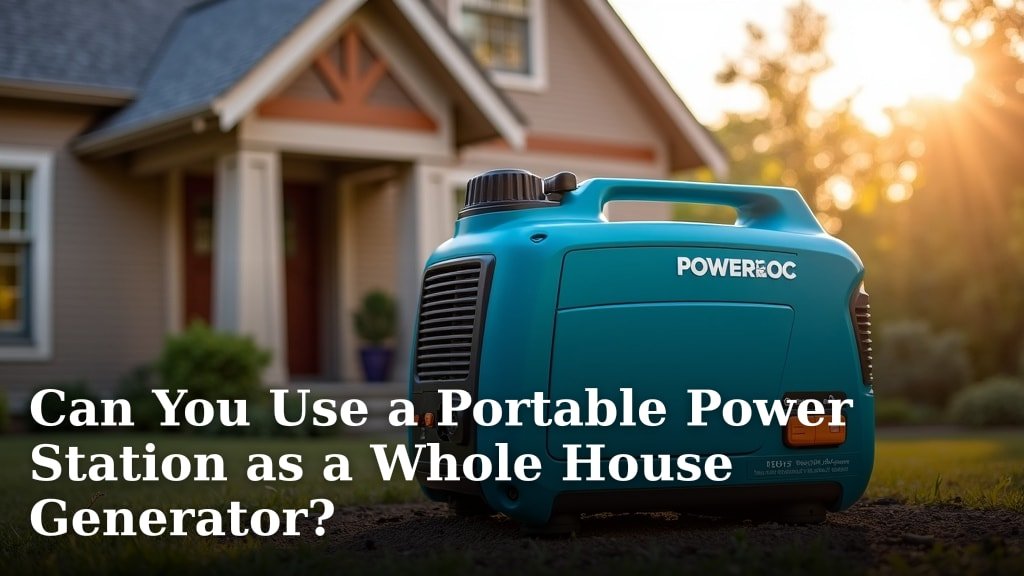
No, you generally cannot use a portable power station as a whole house generator for extended periods or to power every appliance. Portable power stations offer limited power output and capacity compared to dedicated whole-house generators.
While a robust portable power station can handle a few essential appliances during an outage, it won’t power your entire home. They’re designed for temporary, smaller-scale energy needs, not complete home backup.
TL;DR: Can You Use a Portable Power Station as a Whole House Generator?
- Portable power stations are not designed for whole-house backup.
- They have limited power output and battery capacity.
- Best for critical appliances only during short outages.
- Dedicated home generators offer much greater power and runtime.
- Consider your actual power needs before choosing a solution.
Are you looking for reliable backup power for your home? Let’s dive into the specifics of what portable power stations can and cannot do for you, and explore better options for whole-house power.
Understanding Portable Power Station Limitations for Home Backup
While portable power stations are fantastic for camping or charging devices, they simply aren’t built to power an entire house. Their design and capacity have distinct limitations when compared to dedicated whole-home generators.
Power Output: Watts vs. Your Home’s Needs
The first major hurdle is power output. Portable power stations typically offer a continuous output ranging from a few hundred watts to perhaps 2,000 or 3,000 watts for larger models. Some very high-end units might reach 5,000 watts. This sounds like a lot, right?
But consider your home. Running just a refrigerator (600-800 watts), a few lights (60-100 watts each), a TV (80-150 watts), and maybe a microwave (600-1500 watts) quickly adds up. If you add your furnace fan (400-800 watts) or a well pump (500-1,000 watts), you’re already pushing the limits of even a powerful portable station.
A typical home can easily draw 5,000 to 10,000 watts or more when major appliances are running. Trying to draw more power than your portable station can provide will cause it to trip its circuit breaker or simply shut down. It’s like trying to fill a bathtub with a teacup – it’s just not the right tool for the job.
Battery Capacity: How Long Can It Run?
Even if a portable power station *could* handle the initial surge of your appliances, its battery capacity is another big limitation. This is measured in watt-hours (Wh) or kilowatt-hours (kWh). Most portable stations offer between 500 Wh and 2,000 Wh. Larger, more expensive models might hit 5,000 Wh.
Let’s do some quick math. If your essential home loads average 1,000 watts per hour (a conservative estimate), a 2,000 Wh power station would only last about two hours. Even a 5,000 Wh station would give you only five hours. That’s hardly enough for a typical power outage, which can last much longer.
Whole-house generators, on the other hand, run on natural gas or propane and can operate for days or even weeks as long as fuel is supplied. This extended runtime is where they truly shine for home backup.
What Portable Power Stations ARE Good For
Don’t get us wrong, portable power stations are incredibly useful! They just have a different purpose than whole-house backup. Think of them as your reliable sidekick for specific situations.
Camping and Outdoor Adventures
This is where portable power stations truly excel. They can charge your phones, laptops, run portable fans, power small mini-fridges, and even operate a portable projector for an outdoor movie night. They’re quiet, emission-free (when operating), and easy to move around your campsite.
Emergency Essentials During Short Outages
If you’re facing a brief power cut, a portable power station can keep critical items running. Imagine keeping your Wi-Fi router on so you can stay connected, charging your phone, or powering a CPAP machine overnight. We’ve found they’re fantastic for:
- Charging mobile devices and laptops
- Running a few LED lights
- Powering a small fan or personal heater
- Keeping a medical device operational (like a CPAP)
- Operating a mini-fridge or cooler to save essential food
For these specific, limited tasks, a portable power station is a far more convenient and quieter option than firing up a noisy gas generator.
Comparing Power Solutions: Portable Station vs. Whole-House Generator
To really see the difference, let’s look at what each solution brings to the table. It helps to match the tool to the job.
| Feature | Portable Power Station | Whole-House Generator |
|---|---|---|
| Power Output | Low to Moderate (0.5 kW – 5 kW) | High (7 kW – 22 kW+) |
| Fuel Source | Internal Battery (recharges via AC, solar, car) | Natural Gas, Propane |
| Runtime | Hours (limited by battery capacity) | Days to Weeks (as long as fuel supplied) |
| Installation | None (plug and play) | Professional installation required |
| Noise Level | Very Quiet (no engine) | Loud (internal combustion engine) |
| Emissions | None during operation | Yes, exhaust fumes (CO risk) |
| Cost | $300 – $4,000 | $5,000 – $20,000+ (installed) |
| Best Use | Camping, small electronics, short outages for essentials | Full home backup, extended outages, critical systems |
When to Consider a Whole-House Generator
If your goal is to keep your entire home running smoothly during an outage, a whole-house generator is the clear winner. Many experts say these units offer peace of mind that a portable solution just can’t match. Here’s why you might need one:
- You experience frequent or long power outages.
- You have medical equipment that absolutely must stay powered.
- You want your HVAC system, water heater, and major kitchen appliances to operate normally.
- You work from home and cannot afford any downtime.
- You want automatic power restoration without lifting a finger.
These generators are permanently installed, often connected directly to your home’s natural gas line, and turn on automatically when the power goes out. No need to refuel, no extension cords, just seamless power.
Hybrid Solutions: Can They Work Together?
Perhaps you don’t need a full whole-house generator, but a portable station feels a bit too small. Is there a middle ground? Sometimes, yes! You can use a portable power station to run specific critical circuits in your home if you have a transfer switch installed for those circuits. However, this still doesn’t constitute whole-house power.
Some homeowners also pair a smaller, traditional portable generator (gasoline-powered) with a portable power station. The gas generator handles the heavier loads, and the power station takes care of quiet nighttime power or sensitive electronics. This combo can offer more flexibility, but it’s still not a true whole-house solution.
Your Power Needs: A Quick Checklist
Before you decide on any power solution, take a moment to assess your actual needs. This simple checklist can guide you:
- What are the absolute essential appliances you need to run? (e.g., refrigerator, medical devices, Wi-Fi)
- How long do your typical power outages last? (Hours? Days?)
- What is your budget for a backup power system?
- Do you need to power high-draw appliances like an AC unit, well pump, or electric stove?
- Are you comfortable with fueling and maintaining a gas-powered generator?
- Do you prefer a “set it and forget it” automatic system, or are you okay with manual setup?
Answering these questions honestly will help you narrow down your options and choose the most suitable backup power solution for your home and lifestyle.
Conclusion
While portable power stations are incredibly versatile for small-scale needs, they simply aren’t designed to be whole-house generators. You’ve seen the clear differences in power output, battery capacity, and runtime. For keeping essential devices running during short power bumps, a portable station is great. But for true home backup that covers major appliances and extended outages, a dedicated whole-house generator is the reliable solution. Carefully evaluate your home’s unique power demands and outage frequency to make the best choice for your peace of mind.
Frequently Asked Questions
Can a portable power station run a full-sized refrigerator?
Yes, many larger portable power stations can run a full-sized refrigerator for several hours. However, the exact duration depends on the power station’s capacity and the refrigerator’s wattage. It’s usually a temporary solution, not for days on end.
Is it safe to plug a portable power station directly into my home’s wall outlets?
No, you should never plug a portable power station directly into a wall outlet in your home. This can create a dangerous backfeed of electricity onto the grid, risking injury to utility workers and damaging your power station or home electrical system. Always use proper transfer switches or plug appliances directly into the power station.
How can I extend the runtime of my portable power station for essential home items?
To extend runtime, prioritize only the most critical appliances and use energy-efficient models. You can also recharge the power station with solar panels if you have them, or a gas generator if available. Cycling between devices, rather than running everything simultaneously, also helps.
Do portable power stations require maintenance like gas generators do?
Portable power stations require far less maintenance than gas generators. You’ll generally just need to keep them charged, store them in a cool, dry place, and occasionally check the ports for debris. There’s no fuel to stabilize or oil to change.
Can a portable power station power my home’s HVAC system or well pump?
Most portable power stations are not powerful enough to run an entire home HVAC system, which draws significant watts. Some of the very largest portable stations might handle a well pump, but usually only one at a time and for limited durations. These high-demand items are typically better suited for a whole-house generator.
