9 Best Bifacial Solar Panels (November 2026)
The best bifacial solar panels include the Callsun 450W Bifacial Solar Panel 2-Pack for home rooftops, the Callsun N-Type 16BB 400W Bifacial Solar Panel for 60V power stations, and the Callsun N-Type 16BB 400W Bifacial Solar Panel for Class B vans.
On this page (9 sections)
- The best bifacial solar panels in this roundup
- How the best bifacial solar panels compare on wattage and voltage
- How we compared these bifacial solar panels
- Are bifacial panels worth it over standard panels?
- How do I size a bifacial array for a power station?
- Which bifacial panel fits an RV, van or boat roof?
- What should I check before buying a bifacial solar panel by the pallet?
- How do I set up and care for bifacial solar panels?
- Verdict: which bifacial solar panel should you buy?
The best bifacial solar panels for most buyers are the Callsun 450W 2-pack, because two 450W N-Type panels give 900W total with 25.6% efficiency and a dual-module parallel design that keeps half the panel working in partial shade.
If you want a smaller system, the Callsun 2 x 200W pairs and the HQST 200W panel fit vans and power stations far better.
Bifacial means a solar panel captures light on the front and the rear.
The rear side uses reflected and diffuse light from the surface below.
That extra harvest depends on the ground, the mount height and the tilt.
A panel flat on a dark roof will gain little from the back.
A panel raised over a light surface can gain much more.
All picks here use N-Type cells with 25% to 25.6% efficiency and mostly 16BB busbar designs.
Our score weighs specs, features and buyer feedback against what you are shopping for.
We compared wattage, cell type, efficiency, size, weight, voltage, included parts and warranty terms.
We did not test them.
Start with our Solar Panels: The Complete Buying Guide if you are new to sizing a system.
Our picks at a glance
-
1

-
2
 Best for 60V power stations
Callsun N-Type 16BB 400W Bifacial Solar Panel
9.6/10 our score
See it on Amazon -
3
 Best for Class B vans
Callsun N-Type 16BB 400W Bifacial Solar Panel
9.5/10 our score
See it on Amazon
- 4
 Best for campervansCheck it
- 5
 Check it
JJN Bifacial 2Pcs 425 Watt N-Type Solar
Best for 850W arrays - 6
 Check it
JJN Bifacial 425 Watt N-Type Solar Panel
Best for single large panels - 7
 Check it
ZOUPW 480W Bifacial Portable Solar Panel N-Type
Best for portable power stations - 8
 Check it
EPOCH 860W Bifacial Solar Panels
Best for RV and marine pairs - 9
 Check it
STAR 990W Bifacial Solar Panel
Best for frameless designs
The best bifacial solar panels in this roundup
The Callsun 450W 2-pack leads for high-power home and off-grid arrays.
The Callsun 200W pairs lead for vans and 60V power stations.
The ZOUPW 480W leads when you need a panel you can fold, carry and set up in minutes.
What makes a bifacial panel different
A bifacial panel has a transparent backsheet instead of an opaque white back.
Light that passes through or reflects around the panel can hit the rear cells.
Callsun says its design boosts production on ground-mounted and reflective installs.
JJN and HQST cite gains of up to 25% to 30% under suitable conditions.
Why N-Type dominates this list
Every pick here uses N-Type monocrystalline cells.
Callsun rates its panels at 25.6% and links N-Type to higher yield and lower degradation than P-Type.
HQST rates its 200W panel at up to 25.4% and claims a 30-year service life at 87.4% output.
Read what is n type bifacial solar panel first if cell technology is new to you.
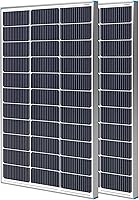
Callsun 450W Bifacial Solar Panel 2-Pack: Best for home rooftops
- 900W total from 2 panels
- N-Type 16BB monocrystalline cells
- 25.6% efficiency
- Double-glass construction
- Dual-module parallel anti-shade design
Two 450W N-Type panels give a high-power pair for rooftops and off-grid arrays, with rear-side capture and half-panel shade tolerance.
Pros
- Highest total wattage in this roundup
- Fewer panels for a large array
- Double-glass build for outdoor use
Cons
- Large panels need strong roof space
- Not a portable choice
The Callsun 450W 2-pack suits home rooftops and off-grid arrays where you want fewer, higher-power modules.
Each panel is rated 450W at 25.6% efficiency, so the pair reaches 900W total.
That cuts wiring, connections and install time versus many smaller panels.
The dual-module parallel design splits each panel into two halves, so one half keeps producing when the other is shaded.
Daily use centres on string design with high-voltage MPPT controllers and inverters.
The 30.08V maximum voltage and 14.97A amperage shape your string layout.
Double-glass construction and an IP68 rating support long-term outdoor use.
The trade-off is size at 69.37 x 44.65 x 1.18 inches per panel.
These are full-size rooftop modules, not a van or camping choice.
Callsun backs them with 10 years of support and a 25-year commitment to at least 84.5% output.
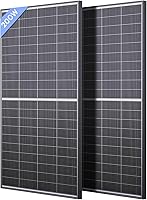
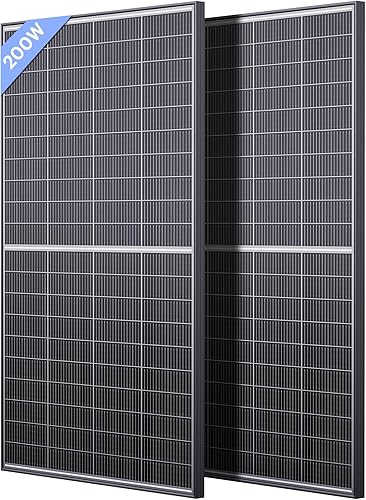
Callsun N-Type 16BB 400W Bifacial Solar Panel: Best for 60V power stations
- 2 x 200W panels in series to 400W
- 25.6% efficiency
- 47.48V Vmp and 54.62V Voc in series
- TwinCell anti-shading design
- 23.8 lb per panel
A matched 2 x 200W pair sized for 60V-class power station inputs, with compact panels for RV, van, marine and rooftop use.
Pros
- Series voltage fits many 60V inputs
- Compact for tight roofs
- Pre-drilled mounting holes
Cons
- Requires series pairing to reach 400W
- Rear gain depends on mount height and surface
This Callsun pair suits buyers feeding a portable power station with a 60V-class input.
Each panel is 200W, and two in series reach 400W at 47.48V Vmp and 54.62V Voc.
That voltage sits safely inside most 60V inputs, so the MPPT controller can work efficiently.
Current stays at 8.43A, which keeps wiring loads modest.
The panels measure 51.3 x 30.3 x 1.4 inches and weigh 23.8 lb each.
That compact footprint fits Class B vans, RVs, marine roofs and home rooftops.
Pre-drilled holes simplify fitment with compatible hardware.
The TwinCell design splits each panel into two independent sections for shade tolerance.
Bifacial gain needs rear access, so it will be small on a low RV roof.
On a raised mount over a light surface it can add real watts.
Callsun cites a -0.30%/K coefficient for hot climates and 10 years of support.
Callsun N-Type 16BB 400W Bifacial Solar Panel: Best for Class B vans
- 2 x 200W N-Type panels
- 25.6% conversion efficiency
- Up to 30% more power with bifacial use
- TwinCell anti-shade design
- 51.3 x 30.3 x 1.4 in per panel
The same 2 x 200W format as the pair above, aimed at Class B vans and tight rooftop spaces with standard mounts.
Pros
- Compact 200W modules
- Compatible with standard Z-brackets and rails
- Low -0.3%/°C temperature coefficient
Cons
- Heavier per watt than the portable pick
- Check exact inches before ordering
This Callsun 200W pair suits Class B van owners who want strong power in a tight footprint.
Each panel is 51.3 x 30.3 x 1.4 inches and 23.8 lb, with 25.6% efficiency.
The pair totals 400W without covering the roof in small modules.
Pre-drilled holes work with standard Z-brackets and universal rails.
The bifacial backsheet can add up to 30% on reflective surfaces like gravel or snow.
In practice, a close van roof limits rear light, while raised mounts help more.
The TwinCell design gives up to 50% better shading tolerance in maker testing.
Weather ratings suit mobile use at 2400 Pa wind and 5400 Pa snow, plus IP68.
The -0.3%/°C coefficient limits heat loss in summer.
Check the exact inches before ordering, since roof space is the limit on most vans.
Against the HQST single, this pair gives more total watts but more weight to lift.
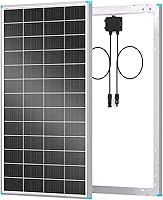
HQST 200W Solar Panel: Best for campervans
- 200W N-Type bifacial panel
- Up to 25.4% efficiency
- Up to 30% more output bifacial
- 30.1 x 47.2 x 1.2 in
- 21.58 lb
A single lighter 200W panel for campervans, with Grade A+ 16BB cells and a 30-year service life claim from HQST.
Pros
- Lighter than the Callsun 200W panels
- Fewer mounts and cables than multiple 100W panels
- All-black anti-corrosion frame
Cons
- Single panel, so plan pairing separately
- Bifacial gain varies with surface and tilt
The HQST 200W panel suits campervan owners who want one lighter module instead of several 100W panels.
It measures 30.1 x 47.2 x 1.2 inches and weighs 21.58 lb, lighter than the Callsun 200W at 23.8 lb.
HQST says it is 13% smaller and 13.3% lighter than standard PERC panels.
Fewer mounts and cables mean fewer parallel connections and less power loss.
Bifacial output is the headline, reaching up to 260W under optimal conditions.
That is up to 30% above its 200W front rating, though real gain varies with surface, height and tilt.
On a flat van roof, expect much less rear gain than the peak figure.
Grade A+ 16BB cells are EL-tested for microcracks, with a claimed 30-year life at 87.4% output.
IP68, 2400 Pa wind and 5400 Pa snow ratings suit RV, trailer, marine and off-grid use.
The trade-off is a single 200W panel, so you must plan pairing separately for higher totals.
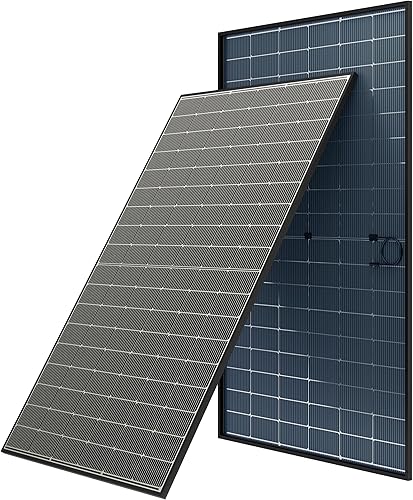
JJN Bifacial 2Pcs 425 Watt N-Type Solar: Best for 850W arrays
- 2 x 425W panels, 850W total
- N-Type 16BB cells
- 25% high efficiency
- UL 61730
- 94.6 lb total
A two-panel 850W set for homes, farms and off-grid systems, with transparent backsheet bifacial capture up to 25%.
Pros
- High total output from two panels
- Pre-drilled mounting holes
- IP65 junction box and IP68 connectors
Cons
- Heavy two-panel set
- Panel only, mounts are separate
This JJN two-panel set suits homes, farms and off-grid systems that need 850W from two modules.
Each panel is 425W at 25% efficiency, for 850W total.
The transparent backsheet allows front and rear generation, with JJN citing up to 25% gain.
N-Type 16BB cells reduce shade impact compared with 9BB and 10BB designs.
Size and weight shape the trade-off at 94.6 lb total for the pair.
That suits a house roof or ground array, but not a small van roof.
Pre-drilled holes support install, and the black frame suits long outdoor exposure.
JJN cites 2400 Pa wind and 5400 Pa snow, an IP65 box and IP68 connectors.
The package is panel only, so budget for mounts, wiring and a controller.
JJN offers a transferable 30-year power output warranty.
Versus the single 425W version, this set doubles output but doubles handling effort.
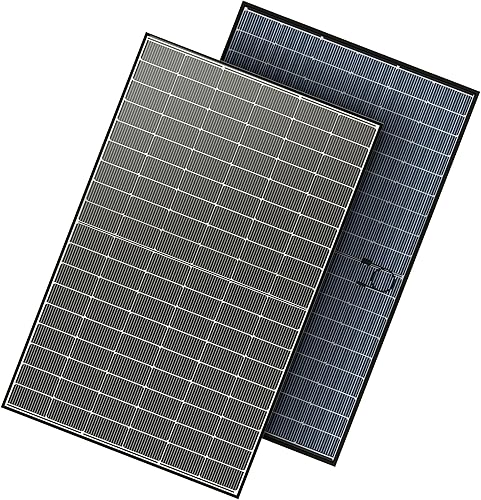
JJN Bifacial 425 Watt N-Type Solar Panel: Best for single large panels
- 425W N-Type bifacial panel
- 25% high efficiency
- UL 61730
- 51.6 lb
- MC4 connector
One large 425W module when you want to build a string panel by panel, for rooftops, RVs, boats and off-grid use.
Pros
- Single-panel flexibility
- Black corrosion-resistant frame
- 2400 Pa wind and 5400 Pa snow ratings
Cons
- Large and heavy for one panel
- No mounts included
This single JJN 425W panel suits buyers who want to build a system one large module at a time.
It shares the bifacial backsheet, N-Type 16BB cells and 25% efficiency of the two-panel set.
One panel gives 425W for a small home array, RV, boat or shed system.
MC4 connectors simplify standard wiring.
The panel weighs 51.6 lb and measures 67.8 x 44.7 x 1.2 inches.
That size needs a real roof area or a supported ground mount.
It is not a grab-and-go camping panel.
Pre-drilled holes help installation, but mounts, cable and a controller are still separate.
Weather performance matches the pair at 2400 Pa wind and 5400 Pa snow.
Output is 31.05V with a 38V maximum, so check controller limits when stringing panels.
JJN offers a 30-year transferable power output warranty.
The trade-off is single-panel flexibility against lower total watts than a matched pair.
ZOUPW 480W Bifacial Portable Solar Panel N-Type: Best for portable power stations
- 480W bifacial portable panel
- 25%+ efficiency
- Foldable, 22.5 lb
- 42.5V architecture
- IP68 waterproof
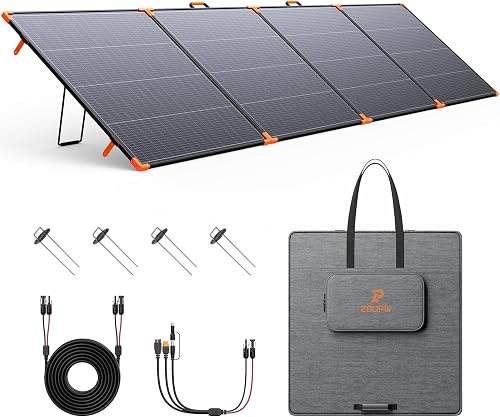
A foldable 480W panel for large power stations, with cables, ground stakes and a storage bag included, and a 36-month warranty.
Pros
- Portable and foldable
- Directly replaces several 100W glass panels
- Includes extension cable and stakes
Cons
- Not for long-term fixed mounting
- Verify 50V+ input on your power station
The ZOUPW 480W panel suits power station owners who want portable high watts without glass panels.
It folds for storage, weighs 22.5 lb and uses composite materials instead of heavy glass.
ZOUPW rates it at 25%+ efficiency with N-Type 16BB cells.
Bifacial gain can reach 30% on snow or sand, and about 10% on grass or concrete.
Setup is the main reason to pick it.
The package includes a storage bag, a 2 ft 4-in-1 cable, a 13 ft extension cable and four ground stakes.
The 42.5V architecture suits large stations with 50V+ solar input.
Cables cover EcoFlow Delta, Bluetti Elite, Anker, Jackery and Anderson-style inputs.
Verify your station input before you connect.
The trade-off is fixed installation, which ZOUPW does not recommend for long-term roof use.
It is a portable and backup panel, not a roof panel.
An IP68 rating and 36-month warranty suit camping and emergency kits.
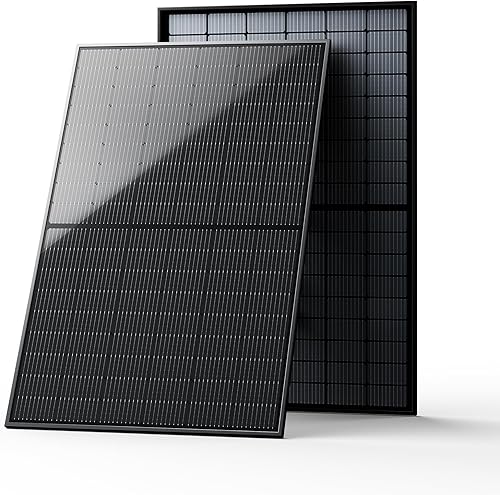
EPOCH 860W Bifacial Solar Panels: Best for RV and marine pairs
- 2 x 430W panels, 860W total
- N-Type Class A cells
- 16BB design
- Up to 25% efficiency
- IP68 junction box
A paired 860W N-Type set for RV, camping, boat, marine and off-grid use, with pre-drilled holes for common mounts.
Pros
- High paired wattage
- Works with Z-brackets, corner, pole and tilt mounts
- 100% EL testing for microcracks
Cons
- Heavy pair at 48.53 kg total
- Panel only in the box
This EPOCH pair suits RV, boat, marine and off-grid buyers who want 860W from two 430W panels.
Each panel uses N-Type Class A cells with 16BB, half-cut cells and bypass diodes.
Efficiency reaches up to 25%, with transparency up to 91.5%.
The bifacial design captures light from both sides for low-light and reflective sites.
Mounting flexibility is a strength.
Pre-drilled holes work with ground, Z-bracket, corner, pole and tilt mounts.
That range makes the pair easier to fit on a cabin, yacht or RV.
MC4 connectors and a junction box are included on the panels.
Weight is the cost at 48.53 kg total, so roof structure matters.
Durability includes snow to 5400 Pa, wind to 2400 Pa, IP68 box and IP67 connectors.
EPOCH offers 12-year quality and 25-year linear output warranties, with 100% EL testing.
Versus JJN, this pair is slightly higher wattage with broader mount compatibility but heavier handling.
STAR 990W Bifacial Solar Panel: Best for frameless designs
- 2 x 495W panels, 990W total
- 25.6% high-efficiency cells
- UL61730 certified
- Frameless design
- IP68
The largest pair here at 990W, with a frameless full-screen design aimed at rain self-cleaning and less dust build-up.
Pros
- Highest total wattage listed
- Frameless design reduces dust and water build-up
- 30-year linear power output warranty
Cons
- Very large 77.2 in panels
- Heavy and roof-focused, not portable
This STAR pair suits DIY roof installs where you want the largest total wattage here.
Two 495W panels give 990W total, with 25.6% N-Type cells and 16BB design.
The frameless full-screen design prevents dust and water build-up at frame edges.
STAR says rain cleans the surface, which cuts cleaning time over the years.
Bifacial gain is quoted up to 25.6% extra versus conventional monofacial panels.
STAR also claims 15% more generation from the frameless design alone.
Treat those as maker claims under ideal conditions.
Real rear gain still depends on surface, mount height and tilt.
Each panel is 77.2 x 44.6 x 1.1 inches and the pair weighs 58.2 lb.
That needs a large, strong roof or a ground array.
UL61730 certification and 100% EL testing support outdoor use.
STAR offers 12-year quality and 30-year linear power output warranties.
How the best bifacial solar panels compare on wattage and voltage
The STAR pair leads on total wattage at 990W.
The Callsun 450W pair follows at 900W.
The EPOCH pair gives 860W and the JJN pair gives 850W.
The ZOUPW portable panel gives 480W from one foldable unit.
The Callsun 200W pairs give 400W each, and the HQST gives 200W single.
Voltage matters as much as wattage for power stations.
The Callsun 200W pair in series gives about 54.6V open circuit for 60V inputs.
The ZOUPW panel outputs 42.5V, so it needs a station accepting 50V or more.
Larger 425W to 495W panels target charge controllers and inverters.
| Product | Best for | Maximum power | Efficiency | Size | Our score |
|---|---|---|---|---|---|
| Callsun 450W Bifacial Solar Panel 2-Pack | home rooftops | 450 watts each | 25.6% | 69.37 x 44.65 x 1.18 in | 9.7 |
| Callsun N-Type 16BB 400W Bifacial Solar Panel | 60V power stations | 400 watts total | 25.6% | 9.6 | |
| Callsun N-Type 16BB 400W Bifacial Solar Panel | Class B vans | 400 watts total | 25.6% | 9.5 | |
| HQST 200W Solar Panel | campervans | 200 watts | 25.4% | 47.2 x 30.1 x 1.2 in | 9.2 |
| JJN Bifacial 2Pcs 425 Watt N-Type Solar | 850W arrays | 850 watts total | 25% | 8.9 | |
| JJN Bifacial 425 Watt N-Type Solar Panel | single large panels | 425 watts | 25% | 8.8 | |
| ZOUPW 480W Bifacial Portable Solar Panel N-Type | portable power stations | 480 watts | 25%+ | 8.5 | |
| EPOCH 860W Bifacial Solar Panels | RV and marine pairs | 860 watts total | Up to 25% | 8.3 | |
| STAR 990W Bifacial Solar Panel | frameless designs | 990 watts total | 25.6% | 8.0 |
How we compared these bifacial solar panels
We compared front rating, rear design, cell type, efficiency, size, weight, voltage, parts and warranty.
We checked which panels are single units, matched pairs or portable.
That split matters because a 900W roof pair and a 480W foldable panel solve different problems.
We also checked shade tolerance and temperature behaviour.
Callsun TwinCell designs keep one half working in partial shade.
HQST and JJN cite 16BB designs that reduce hot spots.
Callsun cites -0.3%/°C, so hot roofs lose less output over time.
We did not test these panels.
Scores come from specs, features and buyer feedback.
Bifacial gain claims are maker claims, and real gain depends on surface, height and tilt.
Are bifacial panels worth it over standard panels?
Bifacial panels are worth it when the rear side can see light.
Ground panels over gravel, sand, snow or a light roof gain the most.
Tilt mounts raised above a surface also gain more than flat roof panels.
A panel flush on a dark flat roof gains little from the back.
Shade tolerance is a second benefit on some models.
Callsun splits into two halves, so shade on one half does not stop the other.
That helps roofs with chimneys, trees or vents.
If you ask Is It Worth Buying Solar Panels for a Power Station?, start with voltage fit.
A fixed 850W pair is poor value for a station if input voltage is wrong.
A foldable 480W panel is poor value as a permanent roof panel if fixed mounting is not recommended.
When bifacial gain is real
Gain is real on high-albedo surfaces.
Snow, sand, light gravel and white roofs reflect more light to the rear.
ZOUPW notes up to 30% on snow or sand and about 10% on grass or concrete.
HQST notes the same pattern for its 200W panel.
When it is not
Gain is small on dark, flat, low mounts.
A van roof inches above a dark surface gives rear cells little light.
Buy on front wattage, efficiency and weight in that case, not peak claims.
How do I size a bifacial array for a power station?
Size by voltage first, then by wattage.
A station has a maximum solar input voltage and current.
Exceeding voltage can damage the input.
Staying well under it can waste MPPT efficiency.
The Callsun 2 x 200W series pair at about 54.6V fits 60V-class stations well.
Check open-circuit voltage, not just the wattage label.
Series adds voltage, while parallel adds current.
The ZOUPW 42.5V panel needs a station accepting that voltage.
Callsun 450W panels at 30.08V suit higher-voltage strings with MPPT controllers.
Series versus parallel for portable panels
Series raises voltage and suits higher input limits.
It keeps current lower, so cable losses drop.
Parallel raises current for lower-voltage inputs, but needs thicker cables.
Match wiring to your station manual, not peak wattage alone.
A reflector can help the rear side
A reflector behind a raised, tilted panel can bounce more light to the rear.
That only helps with a raised and angled setup.
Our bifacial solar panel reflector guide covers options for ground setups.
Which bifacial panel fits an RV, van or boat roof?
Roof space decides the pick.
Class B vans suit the 200W class.
Callsun 200W at 51.3 x 30.3 inches and HQST 200W at 47.2 x 30.1 inches fit tight roofs.
HQST is lighter at 21.58 lb, so it is easier to handle on a ladder.
Larger RVs and boats can take 425W to 495W panels.
JJN 425W, EPOCH 430W and STAR 495W each need a large clear area.
Check roof structure, weight limits and wiring paths first.
A panel too heavy for the roof is not a good buy at any wattage.
Flat roofs limit rear gain, so raised mounts help if you want bifacial benefit.
Shade tolerance matters where air conditioners, vents and trees cast moving shadows.
100W versus 200W versus 400W+ for mobile use
Smaller panels are easier to mount and replace.
Larger panels need fewer mounts and cables for the same watts.
Our best 100w bifacial solar panel guide covers the low end.
The best bifacial solar panels 200w guide covers 200W class depth.
Mounts and wiring on tight roofs
Use mounts matching pre-drilled holes.
Callsun fits standard Z-brackets and universal rails.
EPOCH lists Z-brackets, corner, pole and tilt mounts.
Keep RV cables short, and seal roof penetrations properly.
What should I check before buying a bifacial solar panel by the pallet?
Pallet buying suits installers and large off-grid projects, not one home roof.
Volume lowers cost per watt, but adds storage, handling and breakage risk.
Glass panels are heavy, so a pallet needs a forklift or careful plan.
Check cell type, efficiency and warranty before pallet prices.
N-Type 16BB at 25% to 25.6% will out-produce lower efficiency over time.
A 25 to 30 year power warranty matters more at pallet scale.
So does EL testing for microcracks.
Our bifacial solar panels by pallet guide covers quantity and storage.
For fewer than 10 panels, single-pair pricing is usually simpler.
How many panels do you actually need?
Start with daily energy use and battery or inverter size.
Panels are rated under standard conditions, so real output will be lower in heat and low sun.
Oversizing a little helps cloudy days, but past your controller limit it wastes money.
Storage and handling for bulk orders
Store panels flat, dry and supported across the frame.
Do not stack heavy loads on a panel face.
Inspect each panel for cracked glass on arrival.
Photograph damage before signing, since warranty claims need evidence.
How do I set up and care for bifacial solar panels?
Mount with rear access if you want bifacial gain.
Ground, tilt and raised roof mounts all help.
Keep the rear clear of debris and stored items that block light or trap heat.
Clean both faces gently with water and a soft cloth.
Keep cables dry and off the ground where you can.
IP68 boxes resist water, but they do not fix loose wiring.
Check mounts after storms, since 2400 Pa is a rating, not a promise for a loose mount.
For portable use, fold the ZOUPW panel as directed and use ground stakes in wind.
Do not step on it or place heavy objects on it, since that can crack cells.
Cleaning without damaging the glass
Rinse with clean water first.
Wash with a soft cloth and mild soap if needed.
Rinse again and let the panel air dry.
Avoid abrasive pads and harsh chemicals that scratch coatings.
What to check each season
Check mounts, cable insulation and connector fit.
Look for cracked glass, edge delamination and frame corrosion.
Confirm your controller or station still shows normal voltage and current.
Replace damaged cables before they cause a bigger fault.
Verdict: which bifacial solar panel should you buy?
The best bifacial solar panels depend on where the panel will live.
Pick the Callsun 450W 2-pack for a home or off-grid array needing 900W.
Pick a Callsun 2 x 200W pair for a 60V station or Class B van.
Pick HQST 200W for a lighter single campervan panel.
Pick JJN or EPOCH pairs for 850W to 860W fixed arrays.
Pick STAR 990W for highest watts and a frameless design.
Pick ZOUPW 480W for portable camping or backup power, after verifying input voltage.
Measure your roof or mount area, check controller limits, and confirm inches and weight.
Then choose the panel that fits those limits with the best efficiency and warranty.
See also Best Solar Panel For Camping and bifacial solar panels 500w.
Our top 3 picks at a glance
-
1
-
2
Best for 60V power stations
Callsun N-Type 16BB 400W Bifacial Solar Panel
9.6/10 our score
See it on Amazon -
3
Best for Class B vans
Callsun N-Type 16BB 400W Bifacial Solar Panel
9.5/10 our score
See it on Amazon
Frequently asked questions
How much extra power does a bifacial panel make?
It depends on the surface below the panel. HQST and Callsun cite up to 30% more with bifacial use on reflective surfaces like gravel or snow.
ZOUPW notes about 10% is realistic on grass or concrete.
Mount height and tilt change the result.
Do bifacial panels work on flat RV roofs?
They can, but rear-side gain will be low when the panel sits close to the roof. You still get the front-side rating, plus shade tolerance on some models.
Raise the mount or choose a ground or tilted setup if you want more rear capture.
Are N-Type bifacial panels better than P-Type?
N-Type cells in this roundup offer 25% to 25.6% efficiency, lower degradation claims and better low-light behaviour than older P-Type designs. Callsun and HQST link N-Type to longer service life.
Check the exact efficiency and warranty for each panel.
Can I use bifacial panels with a portable power station?
Yes, if voltage and current fit your station. The Callsun 2 x 200W pair in series reaches about 54.6V open circuit, which suits many 60V-class inputs.
ZOUPW says verify a 50V+ input before connecting its 42.5V panel.