9 Best Quiet Inverter Generators (November 2026)
The best quiet inverter generators include the Westinghouse 5000 Peak Watt Super Quiet Portable for RV backup power, the WEN Super Quiet 2350-Watt Portable Inverter Generator for lightweight camping, and the Oxseryn Power Equipment 4400 Watts Inverter Generator for value-focused RV loads.
On this page (7 sections)
- The best quiet inverter generators for different needs
- How do you choose a quiet inverter generator?
- How should you compare inverter generator noise?
- Which quiet inverter generator is best for an RV?
- Is a gas generator better than a quiet power station?
- How do you set up and care for a quiet inverter generator?
- Which quiet inverter generator should you buy?
The best quiet inverter generator for most RV and home backup needs is the Westinghouse 5000 Peak Watt Super Quiet Portable. It combines 3900 rated watts, a 52 dBA low noise claim, remote start and an RV-ready outlet.
Quiet inverter generators vary widely in output, weight and how their noise figures are measured. For the compact output class, compare 2000-watt portable generators.
A compact 1900 running watt model may be easier to carry, while a 4000 rated watt unit gives more room for RV appliances and home essentials.
For background, start with what is a portable inverter generator. If you're comparing generator designs, our inverter generator vs regular generator guide explains why inverter models are often chosen for electronics and quieter operation.
Our picks at a glance
-
1
 Best for RV backup power
Westinghouse 5000 Peak Watt Super Quiet Portable
9.7/10 our score
See it on Amazon -
2
 Best for lightweight camping
WEN Super Quiet 2350-Watt Portable Inverter Generator
9.6/10 our score
See it on Amazon -
3
 Best for value-focused RV loads
Oxseryn Power Equipment 4400 Watts Inverter Generator
9.5/10 our score
See it on Amazon
- 4
 Check it
PowerSmart 4000 Watt Portable Inverter Generator
Best for parallel-ready home use - 5
 Check it
Pulsar PGD40ISCO Ultra Light Quiet 4000W Portable
Best for compact RV power - 6
 Check it
WEN Quiet and Lightweight 4800-Watt RV-Ready Portable
Best for RV outlet capacity - 7
 Check it
Westinghouse 4000 Peak Watt Super Quiet Dual
Best for dual-fuel flexibility - 8
 Check it
SIOKIUU 2500W Portable Generator Super Quiet Inverter
Best for long light-duty runtime - 9
 Check it
Genkins 8000W Portable Quiet Inverter Generator
Best for high-output home backup
The best quiet inverter generators for different needs
The best quiet inverter generator depends on your required running watts, noise target, fuel choice and carrying plan. We compared the stated sound levels, rated output, outlet layouts and practical use cases for these 9 models.
Our score weighs specifications and features against the needs behind this keyword. Sound figures are not perfectly comparable when one brand reports quarter-load noise and another reports distance from 23 feet.
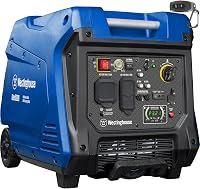
Westinghouse 5000 Peak Watt Super Quiet Portable: Best for RV backup power
- 5000 peak watts
- 3900 rated watts
- 52 dBA low noise output
- Remote electric start
- RV-ready TT-30R outlet
This model combines strong rated output with a 52 dBA low noise claim, an RV-ready outlet, remote start and up to 18 hours of run time.
Pros
- 3900 rated watts
- Remote and electric start
- RV-ready outlet
- Up to 18 hours of run time
Cons
- 104.7 lb weight
- Gasoline only
Westinghouse is the strongest all-around pick when you need substantial output without moving into the largest generator size. It produces 3900 rated watts and 5000 peak watts, giving it more operating headroom than the compact models.
The stated noise output is as low as 52 dBA. That figure is most useful when you compare it with the same load and measuring conditions from another generator.
The TT-30R 30 amp outlet makes it a natural match for travel trailers. Two USB outlets and a 120V duplex household outlet also support smaller electronics and household devices.
Remote electric start, electric start and recoil start give you several ways to turn it on. For more push-button and remote-start choices, see electric start generators.
The rotating display shows fuel level, power output, remaining run time, voltage and lifetime hours.
The 3.4 gallon tank can run up to 18 hours, according to the stated specifications. Eco Mode adjusts fuel use for changing demand, but your actual runtime will depend on the connected load.
Choose it if you want a quiet generator with strong RV output and useful controls. Its 104.7 lb weight means you'll want to plan storage and loading before buying.
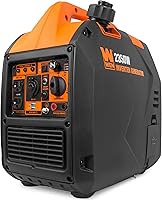
WEN Super Quiet 2350-Watt Portable Inverter Generator: Best for lightweight camping
- 2350 surge watts
- 1900 rated watts
- 51 dBA at quarter load
- 39 lb body
- Fuel shutoff
The 39 lb WEN is the easiest pick here to carry and store. Its 1900 rated watts suit smaller electronics, lights and modest camping loads.
Pros
- Lightest pick here
- 51 dBA at quarter load
- Fuel shutoff
- USB ports
Cons
- Lower output than larger picks
- Gasoline only
The WEN 2350 is the easiest pick to carry because it weighs 39 lb. Its 1900 rated watts are enough for smaller electronics, lights, phones, tablets, televisions and other modest loads.
WEN lists 51 dBA at quarter load, which is the lowest stated figure in this group. Because the measurement is tied to quarter load, do not expect the same sound level when the generator is working harder.
The generator produces 2350 surge watts and clean power with total harmonic distortion below 0.3% at no load and below 1.2% at full load. That makes it a reasonable match for sensitive electronics.
Two 120V receptacles, a 12V DC receptacle and two 5V USB ports cover common camping and emergency charging needs. Fuel shutoff uses remaining carburetor fuel before shutdown, which can help reduce stagnant fuel in the carburetor.
Choose it for camping, tailgating or light backup power where portability matters more than high output. It is not the right fit for a load that regularly approaches 1900 running watts.
Oxseryn Power Equipment 4400 Watts Inverter Generator: Best for value-focused RV loads
- 4400 peak watts
- 3400 running watts
- 72 dBA under 23 ft
- RV port
- Up to 14 hours at 25% load
Oxseryn offers 3400 running watts, an RV port and a 56 lb frame. It fits buyers who need more output than a compact generator and can accept a higher stated noise level.
Pros
- 3400 running watts
- 56 lb weight
- RV port
- Fuel gauge
Cons
- Higher noise figure than quieter picks
- Gasoline only
Oxseryn fits buyers who want 3400 running watts in a 56 lb portable frame. Its 4400 peak watts and RV port give it more capacity for RV or home backup loads than the compact 1900 watt picks.
The stated sound level is under 72 dBA from 23 feet. That is a higher figure than the other mid-size options here, so place quiet operation ahead of output only if your use allows a smaller model.
Its 2 gallon tank can run up to 14 hours at 25% load with ECO mode. A fuel gauge helps you check the remaining fuel without guessing from the tank.
The panel includes 2 120V AC ports, a 12V DC port and an RV port. Low-oil shutdown and overload protection are listed features for routine operation.
Choose Oxseryn when output and a moderate 56 lb weight matter more than the lowest sound figure. For a campsite near sleeping areas, compare its noise claim carefully with the 51 to 62 dBA options.
PowerSmart 4000 Watt Portable Inverter Generator: Best for parallel-ready home use
- 4000 starting watts
- 3200 running watts
- 59 dBA from 23 ft
- Parallel connection
- Eco Mode
PowerSmart balances 3200 running watts with a 59 dBA noise claim and parallel capability. It suits home users who may later connect two compatible units.
Pros
- 3200 running watts
- 59 dBA from 23 ft
- Parallel ready
- Eco Mode
Cons
- Parallel kit sold separately
- Recoil start
PowerSmart gives you 3200 running watts and a stated 59 dBA noise level from 23 feet. It is a useful middle ground for home use, camping and loads that need more room than a 1900 watt generator provides.
The panel has a 120V 20A duplex outlet, a 120V 30A twist-lock outlet, a 12V DC port and dual USB ports. Eco Mode can reduce fuel use as demand changes.
Two compatible 4000W generators can be connected in parallel to increase output, but the parallel kit is sold separately. Confirm the exact compatible setup before planning around a second unit.
At 50.7 lb, it is lighter than the larger RV-ready models. It uses recoil start, so keep the starting method in mind if easy push-button ignition is a priority.
Choose PowerSmart when you want a balanced 3200 running watts, 59 dBA figure and future parallel capability. It suits buyers who need flexibility but do not need dual-fuel operation.
Pulsar PGD40ISCO Ultra Light Quiet 4000W Portable: Best for compact RV power
- 4000 peak watts
- 3200 rated watts
- 59 dB operation
- 47.3 lb weight
- Parallel ready
Pulsar keeps 3200 rated watts in a compact 47.3 lb design. Its stated uses include RVs, sensitive electronics and air-conditioning units up to 13,500 BTU.
Pros
- 3200 rated watts
- 47.3 lb weight
- 59 dB operation
- Parallel ready
Cons
- 4-hour half-load run time
- Gasoline only
Pulsar is a compact option for RV use because it puts 3200 rated watts in a 47.3 lb body. The stated 59 dB operation and parallel-ready design add flexibility for portable use.
Its 1 gallon tank provides 4 hours of run time at half load. That is a shorter stated runtime than several larger-tank options, so it fits short sessions better than unattended extended backup.
Pulsar identifies the generator for emergency power, RV use, sensitive electronics and air-conditioning units up to 13,500 BTU. Check your specific appliance's starting and running demand before relying on that use case.
The generator is gas powered and uses a 4-stroke engine. Its small dimensions and low weight make storage and transport simpler than with the 72.7 lb and 104.7 lb models.
Choose Pulsar when compact RV power matters more than long tank runtime. Its 3200 rated watts give it more headroom than the smallest picks, but the 4-hour half-load figure needs planning.
WEN Quiet and Lightweight 4800-Watt RV-Ready Portable: Best for RV outlet capacity
- 4800 surge watts
- 4000 rated watts
- 62 dBA at quarter load
- TT-30R RV receptacle
- CO shutdown sensor
This WEN gives the highest rated output among the mid-size picks, plus wheels, a telescoping handle and an RV receptacle. Its 72.7 lb weight matters when loading it.
Pros
- 4000 rated watts
- RV-ready outlet
- CO shutdown sensor
- Onboard wheels
Cons
- 72.7 lb weight
- 62 dBA at quarter load
This WEN is the strongest fit when you need 4000 rated watts and an RV-ready outlet. Its 4800 surge watts, TT-30R receptacle and four 120V receptacles support a broader load plan than the smaller models.
The 224cc engine operates at a stated 62 dBA at quarter load. That is still a quiet-generator claim, but it is higher than the 51 to 59 figures on several smaller choices.
Wheels and a telescoping pull handle help move the 72.7 lb unit. The 1.9 gallon tank provides up to 7 hours at half load, according to the stated product information.
A CO shutdown sensor automatically turns the generator off if dangerous carbon monoxide levels are detected. Fuel shutoff uses remaining carburetor fuel before shutdown, and the panel includes USB and 12V DC outlets.
Choose it for RV or home backup where 4000 running watts matter more than minimum weight. If you plan to power indoor loads, read about running generator cords into a house.
Measure your storage area and route to the operating location before choosing a unit this size.
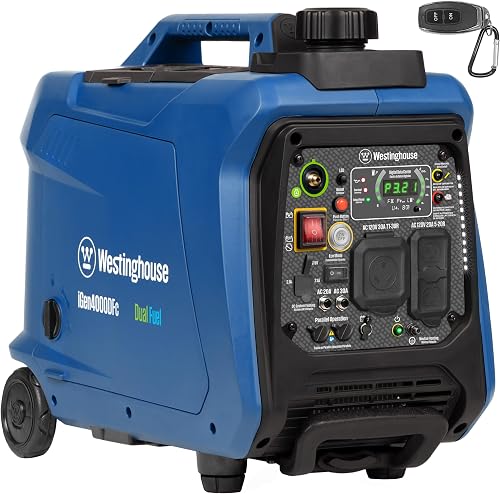
Westinghouse 4000 Peak Watt Super Quiet Dual: Best for dual-fuel flexibility
- 4000 peak watts
- 3300 rated watts
- 52 dBA low noise output
- Gasoline or propane
- Remote electric start
The dual-fuel Westinghouse gives 3300 rated watts and a choice of gasoline or propane. It also adds remote start, a CO sensor and an RV-ready outlet.
Pros
- Gasoline or propane
- 52 dBA low noise output
- Remote start
- 3300 rated watts
Cons
- 62.8 lb weight
- 7-hour stated run time
The dual-fuel Westinghouse is the best choice here when fuel flexibility matters. It produces 3300 rated watts and can run on gasoline or propane, which may help when one fuel is easier to store or obtain.
For another fuel choice, compare diesel inverter generators.
It lists noise as low as 52 dBA and includes remote, electric and recoil start. For more choices, compare quiet dual-fuel inverter generators.
The TT-30R RV outlet, household outlet and USB ports support both travel trailer and home backup use.
A CO sensor and automatic low-oil shutdown add safety controls. The digital display rotates through fuel level, power output, remaining run time, voltage and lifetime hours.
The gasoline tank is 1.69 gallons, with up to 7 hours of stated run time. Its weight is 62.8 lb, which is manageable for some users but heavier than the 39 lb and 47.3 lb compact options.
Choose this model if propane capability is worth more to you than the longer runtime of the gasoline-only Westinghouse 5000. Our gas generator buying guide covers fuel storage and generator setup basics.
SIOKIUU 2500W Portable Generator Super Quiet Inverter: Best for long light-duty runtime
- 2500 peak watts
- 1900 running watts
- Under 59 dBA from 23 ft
- Up to 17 hours at 25% load
- CO sensor
SIOKIUU pairs 1900 running watts with a claimed 17-hour runtime at 25% load. It is suited to light camping and emergency loads that stay below its output.
Pros
- Up to 17 hours at 25% load
- 39.46 lb weight
- CO sensor
- Parallel function
Cons
- 1900 running watts
- Gasoline only
SIOKIUU suits light-duty backup where long runtime matters more than high output. It produces 1900 running watts and can operate up to 17 hours at 25% load from a 1.06 gallon tank.
The stated sound level is under 59 dBA from 23 feet. It also weighs 39.46 lb and has a carrying handle, so it stays close to the WEN 2350 in portability.
The 2500 peak watt output can handle starting demand only when the connected load remains within the generator's limits. Add running watts and starting watts before connecting multiple devices.
A CO sensor can shut the unit down if carbon monoxide reaches dangerous levels. The generator also has ECO mode and a parallel function for connecting two SIOKIUU generators.
Choose it for camping, lights, charging and small appliances that stay below 1900 running watts. Do not choose it for a large RV or home load simply because its peak number is 2500 watts.
Genkins 8000W Portable Quiet Inverter Generator: Best for high-output home backup
- 8000 peak watts
- 6500 rated watts
- 62 dBA from 23 ft
- Electric start
- 240V outlet
Genkins is the high-output choice, with 6500 rated watts, 240V capability and a 4 gallon tank. Its 112 lb weight makes it a home backup unit rather than a casual carry.
Pros
- 6500 rated watts
- 240V outlet
- Electric start
- Up to 16 hours at 25% load
Cons
- 112 lb weight
- 62 dBA from 23 ft
Genkins is the high-output pick, with 6500 rated watts and 8000 peak watts. Its 240V NEMA L14-30R outlet adds capability that the smaller 120V-focused generators do not provide.
The stated noise level is 62 dBA from 23 feet. That is quieter than many traditional open-frame generators may be, but the 112 lb weight makes this a home backup unit rather than a simple camping carry.
Its 4 gallon tank is rated for 16 hours at 25% load and 8 hours at 50% load. ESC mode adjusts engine speed for fuel efficiency as demand changes.
Electric start and a digital display make operation easier to manage. Listed outlets include one 240V outlet, one 120V L5-30R outlet and two 120V household outlets.
Choose Genkins when your load plan needs 6500 running watts, 240V capability or long runtime. Choose a smaller unit if you mainly need phone charging, lights or a few camping appliances.
How do you choose a quiet inverter generator?
Choose by running watts first, then compare noise, fuel, outlets and weight. Peak watts cover short starting demand, while rated watts describe continuous power.
List the devices you need at the same time. A phone charger and lights need far less than a refrigerator, air conditioner or kettle together.
Add running watts for each device and note motors or compressors, since starting demand can be higher. Write the list down before shopping so peak watts do not hide a shortfall.
For light loads, WEN 2350 and SIOKIUU give 1900 running watts. PowerSmart and Pulsar give 3200, while WEN 4800 and Westinghouse 5000 give 4000 and 3900 rated watts.
A 1900 watt unit suits lights, phones, tablets and small appliances. The 3200 to 4000 watt models leave room for RV appliances and home essentials.
If you may add loads later, choose the higher class now. It is easier to run a larger unit lightly than overload a smaller one.
Check outlets next, because enough power can still mean the wrong plug. RV, household, USB and 12V DC outlets each serve different loads.
Consider fuel and runtime in daily use, not tank size alone. A long light-load runtime can drop sharply when several appliances are connected.
Weigh the unit and picture its storage spot. A lighter model is simpler to carry, while a heavier one may need wheels and a planned route.
Finally, check start method and safety features. Remote or electric start can help in RV use, while a CO sensor and low oil shutdown add protection.
How should you compare inverter generator noise?
Compare the dBA number, load and measuring distance together. A 51 dBA result at quarter load is not a direct match for a figure measured from 23 feet, and a generator generally works harder as you add devices.
The WEN 2350 lists 51 dBA at quarter load. The Westinghouse 5000 and Westinghouse dual-fuel models list output as low as 52 dBA, while PowerSmart and Pulsar list 59 dBA figures.
Read the condition beside each number before you rank them. A lower figure can reflect lighter load or a different measuring setup rather than quieter use with your appliances.
Place any fuel generator outdoors, away from doors, windows and vents. Carbon monoxide is dangerous and cannot be judged by sound level, so use the model's safety features and follow its operating instructions.
Which quiet inverter generator is best for an RV?
The best RV choice depends on the RV receptacle and power demand. A TT-30R outlet is included on the Westinghouse 5000, WEN 4800 and Westinghouse dual-fuel models, while Oxseryn includes an RV port.
Size the generator from the RV load, not the generator label. Add running watts for the air conditioner, refrigerator, lights, chargers and other devices used together.
Pulsar identifies air-conditioning units up to 13,500 BTU among its intended uses. Confirm your RV startup demand before choosing, especially when running air conditioning with other appliances.
Air conditioning is often the deciding load. Its starting demand can exceed running demand, so leave headroom rather than filling rated watts with other devices.
The Westinghouse 5000 gives 3900 rated watts for a trailer, more continuous room than the 1900 running watt models. That matters when air conditioning runs with a refrigerator and small appliances.
The WEN 4800 offers 4000 rated watts, an RV receptacle, wheels and a telescoping handle. Its 72.7 lb weight means you should plan the route to the campsite before buying.
The dual-fuel Westinghouse gives 3300 rated watts on gasoline or propane, with up to 7 hours stated gasoline run time. Oxseryn provides 3400 running watts and an RV port in a 56 lb frame, but its sound level is under 72 dBA from 23 feet.
Pulsar puts 3200 rated watts in a compact 47.3 lb body for smaller RVs. Its 1 gallon tank gives 4 hours at half load, so it fits shorter sessions better than long backup.
For a broader portable comparison, see our best portable inverter generator guide.
Match the outlet to your RV first, then check running watts against your full load list. That order avoids buying for peak watts and finding too little continuous power.
Is a gas generator better than a quiet power station?
A gas generator can run as long as you have fuel, while a power station runs from stored battery capacity and is silent during use. Your better choice depends on runtime, charging access, load size and whether engine noise is acceptable.
A gas generator suits loads that need continuous output through a long outage or a full camping trip. You can keep it running by refueling, subject to the tank size and the load you connect.
A power station suits quieter, smaller loads where silence matters more than long runtime. It must be recharged from a wall outlet, vehicle or solar input before its stored capacity runs out.
Think about where you will use the power. A fuel generator must stay outdoors and away from doors, windows and vents, while a power station can be used indoors because it does not produce engine exhaust.
Fuel storage is another practical difference. Gasoline needs safe storage and refueling after the engine cools, while a power station needs only a charging source and a charged battery before you leave.
Load size also sets the limit. The gas models here offer running watts from 1900 to 6500, which can cover larger appliances and RV loads that a smaller power station may not support.
Noise tolerance matters at a campsite or in a neighborhood. Even a quiet inverter generator makes engine sound, while a power station is silent during use and may be better near sleeping areas.
For silent indoor-friendly backup, compare this guide with our Best Quiet Portable Power Station picks. Our solar vs gas generator guide explains the trade-offs between fuel supply and battery recharging.
Choose gas when runtime and continuous output lead your list. Choose a power station when silence, indoor use and simple charging matter more than how long it can run.
How do you set up and care for a quiet inverter generator?
Set the generator outdoors in a clear area, keep it dry, and connect only loads that stay within its rated output. Let the engine cool before refueling, and follow the model's instructions for oil, fuel and storage.
Eco modes can reduce fuel use when demand is low. Fuel shutoff features on the WEN models and SIOKIUU use remaining carburetor fuel before shutdown, which can help reduce stagnant fuel during storage.
Keep the unit clean and check its cables, outlets, tires or handles before use. Never connect a portable generator directly to home wiring unless the transfer equipment and installation are designed for that purpose.
Which quiet inverter generator should you buy?
Pick the Westinghouse 5000 if you need strong RV and home backup output with remote start and a 52 dBA low noise claim. Choose the WEN 2350 for the lightest carry, or the Westinghouse dual-fuel model when propane flexibility matters.
The Westinghouse 5000 offers 3900 rated watts and an RV-ready TT-30R outlet, with remote, electric and recoil start. It has a 3.4 gallon tank and up to 18 hours of stated run time.
That combination fits travel trailers and home essentials on one unit. Its 104.7 lb weight is the trade-off, so plan for wheels, a handle and a clear path to storage.
The WEN 2350 weighs 39 lb and provides 1900 rated watts with 51 dBA at quarter load. Choose it for camping, tailgating, phones, tablets, lights and modest backup loads.
Do not stretch that 1900 watt output across a large RV load. It is best where portability matters more than running an air conditioner and several appliances together.
The Westinghouse dual-fuel model gives 3300 rated watts on gasoline or propane, with remote start, a CO sensor, an RV outlet and a 52 dBA low noise claim. Fuel flexibility is its main advantage, while its 62.8 lb weight and up to 7 hour stated run time need weighing in daily use.
For 4000 rated watts, choose the WEN 4800 if you want an RV outlet and CO shutdown sensor. Choose Genkins when 6500 rated watts and 240V capability matter more than portability.
The WEN 4800 has four 120V receptacles, a TT-30R RV receptacle, USB ports and wheels with a telescoping handle. Its 72.7 lb weight and 62 dBA at quarter load should shape your storage plan.
Genkins is the high-output home backup pick with 8000 peak watts and 6500 rated watts, a 240V outlet, electric start and a 4 gallon tank. At 112 lb, it is not a casual campsite carry, so keep it where it can be rolled to an outdoor spot.
PowerSmart and Pulsar sit in the middle at 3200 running or rated watts. PowerSmart adds parallel capability and a 59 dBA claim from 23 feet, while Pulsar offers a compact 47.3 lb body for RV use.
Oxseryn covers 3400 running watts in a 56 lb frame with an RV port, but its under 72 dBA claim from 23 feet is higher than the quieter options. SIOKIUU suits light loads with 1900 running watts, up to 17 hours at 25% load, a CO sensor, ECO mode and parallel function.
The right quiet inverter generator matches running watts, outlet type, sound condition and weight to your actual setup. Before buying, list devices, add running watts, check outlet shapes, and confirm weight, fuel and start method fit your use.
Our top 3 picks at a glance
-
1
Best for RV backup power
Westinghouse 5000 Peak Watt Super Quiet Portable
9.7/10 our score
See it on Amazon -
2
Best for lightweight camping
WEN Super Quiet 2350-Watt Portable Inverter Generator
9.6/10 our score
See it on Amazon -
3
Best for value-focused RV loads
Oxseryn Power Equipment 4400 Watts Inverter Generator
9.5/10 our score
See it on Amazon
Frequently asked questions
What is the quietest inverter generator here?
The WEN 2350 lists 51 dBA at quarter load, while both Westinghouse picks list output as low as 52 dBA. Compare the test distance and load condition before treating any number as a direct winner, because noise changes as engine demand changes.
How quiet should an inverter generator be?
A quiet inverter generator should be judged by its stated dBA level, the distance used for measurement and the load condition. The picks here range from 51 dBA at quarter load to under 72 dBA from 23 feet, so read the full condition beside each number.
What size quiet inverter generator do I need?
Add the running watts of the devices you need at the same time, then account for starting demand from motor-driven loads. A 1900 running watt model fits light electronics and small loads, while 3200 to 4000 rated watts gives more room for RV and home backup use.
Are quiet inverter generators good for RVs?
Yes, if the generator has enough rated output and the right RV receptacle. The Westinghouse 5000, WEN 4800 and Westinghouse dual-fuel models include TT-30R RV outlets.
Check the RV's demand before choosing by peak watts alone.
Do quiet inverter generators use gas?
Most picks here use gasoline, while the Westinghouse 4000 Peak Watt model can use gasoline or propane. Read our guide on do inverter generators use gas for fuel choices, storage and operating differences.